
Five components in a UI form — a checkbox, a dropdown, two text fields, and a submit button — all need to react when each other changes. The checkbox enables the dropdown; the dropdown choice changes which text fields are required; the submit button enables only when all required fields are filled. If each component talks directly to the others, you end up with 5 × 4 = 20 direct dependencies. Add a sixth component and you need to update potentially five existing ones. The Mediator pattern replaces all those direct links with a single hub: components talk only to the mediator, and the mediator coordinates everyone.
The pattern is best understood as the opposite of tight coupling. Without it, N components need O(N²) connections. With it, N components each need exactly 1 connection to the mediator — O(N) total. The tradeoff is that the mediator itself becomes a concentrator of coordination logic, so it needs to be kept focused and testable.
All code compiles and runs with Java 25. No external dependencies required.
Pattern Structure
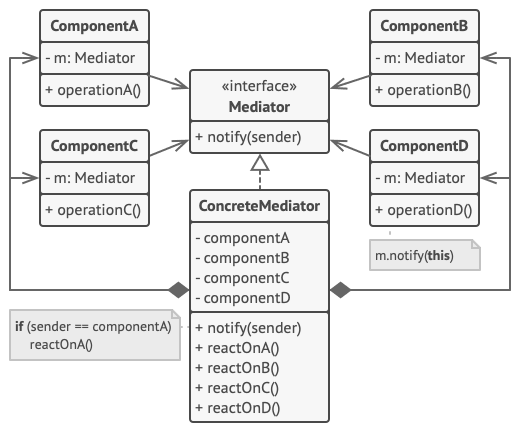
Implementation: Chat Room
A chat room is the canonical Mediator example because it makes the connection topology obvious: users don’t connect to each other — they connect to the room.
ChatMediator.java
package mediator;

/** Mediator interface — defines how colleagues communicate through the hub */
public interface ChatMediator {
    void sendMessage(String message, User sender);
    void addUser(User user);
}
User is the colleague. It knows only the mediator — never the other users directly.
User.java
package mediator;

/**
 * Colleague — knows only the mediator, not other users.
 * Sends messages through the mediator; receives via receive().
 */
public class User {
    private final String name;
    private final ChatMediator mediator;

    public User(String name, ChatMediator mediator) {
        this.name     = name;
        this.mediator = mediator;
    }

    public String getName() { return name; }

    public void send(String message) {
        System.out.println("[" + name + "] sends: " + message);
        mediator.sendMessage(message, this);
    }

    public void receive(String message, String from) {
        System.out.println("  [" + name + "] received from " + from + ": " + message);
    }
}
ChatRoom is the concrete mediator. All coordination logic — who gets which message — lives here, and nowhere else.
ChatRoom.java
package mediator;

import java.util.ArrayList;
import java.util.List;

/**
 * Concrete Mediator — the chat room that routes messages between users.
 * Users talk to ChatRoom; ChatRoom talks to users. Nobody else talks to anybody.
 */
public class ChatRoom implements ChatMediator {
    private final List<User> users = new ArrayList<>();

    @Override
    public void addUser(User user) {
        users.add(user);
        System.out.println("  [ChatRoom] " + user.getName() + " joined the room");
    }

    @Override
    public void sendMessage(String message, User sender) {
        for (User user : users) {
            if (user != sender) {  // don't echo back to sender
                user.receive(message, sender.getName());
            }
        }
    }
}
Main wires up the room and three users, then has each user broadcast a message — note that no user ever references another user directly.
Main.java
package mediator;

/**
 * Mediator Design Pattern — Runnable Demo
 * Run: javac mediator/*.java -d out/mediator && java -cp out/mediator mediator.Main
 * Article: https://ankurm.com/mediator-design-pattern-java/
 */
public class Main {
    public static void main(String[] args) {
        System.out.println("=== Mediator Design Pattern Demo ===\n");

        ChatRoom room = new ChatRoom();

        User alice = new User("Alice", room);
        User bob   = new User("Bob",   room);
        User carol = new User("Carol", room);

        room.addUser(alice);
        room.addUser(bob);
        room.addUser(carol);

        System.out.println();
        alice.send("Hey everyone!");
        System.out.println();
        bob.send("Hi Alice and Carol!");
        System.out.println();
        carol.send("Good morning!");

        System.out.println("\n-- Connections without Mediator: " + 3 + " users need " + (3 * 2) + " direct links --");
        System.out.println("-- With Mediator: " + 3 + " users each connect only to the room --");
        System.out.println("-- With N users: O(N) connections instead of O(N²) --");

        System.out.println("\n=== Demo complete ===");
    }
}
Console Output
[ChatRoom] Alice joined the room
[ChatRoom] Bob joined the room
[ChatRoom] Carol joined the room
[Alice] sends: Hey everyone!
[Bob] received from Alice: Hey everyone!
[Carol] received from Alice: Hey everyone!
[Bob] sends: Hi Alice and Carol!
[Alice] received from Bob: Hi Alice and Carol!
[Carol] received from Bob: Hi Alice and Carol!
[Carol] sends: Good morning!
[Alice] received from Carol: Good morning!
[Bob] received from Carol: Good morning!
— Connections without Mediator: 3 users need 6 direct links —
— With Mediator: 3 users each connect only to the room —
— With N users: O(N) connections instead of O(N²) —
=== Demo complete ===
Mediator in Practice: MVC and Spring Events
MVC (Model-View-Controller) is an architectural application of the Mediator pattern. The Controller is the mediator: the View and Model don’t talk to each other directly — they talk through the Controller. The View fires actions to the Controller; the Controller updates the Model; the Controller updates the View. Removing the direct View-Model coupling is what makes MVC testable and what lets you swap views without touching the model.
Spring’s ApplicationEventPublisher is another implementation. Components publish events to the Spring context (the mediator). Other components subscribe to event types. Publishers and subscribers are completely decoupled — a payment service publishes OrderPaidEvent; the email service, the inventory service, and the analytics service each subscribe to it independently. Adding a new subscriber doesn’t require changing the publisher.
// Spring as Mediator — publisher and subscriber have zero direct dependency
@Service
public class PaymentService {
    private final ApplicationEventPublisher events;
    public void processPayment(Order order) {
        // ... payment logic ...
        events.publishEvent(new OrderPaidEvent(order));  // tell the mediator
    }
}
@Component
public class EmailService {
    @EventListener
    public void onOrderPaid(OrderPaidEvent event) {  // mediator delivers here
        // send confirmation email
    }
}
💡 Mediator vs Observer: They look similar but have different intents. Observer establishes a one-to-many notification channel from a single subject to its subscribers — the subject knows subscribers exist (it manages the list). Mediator establishes many-to-many communication through a hub — colleagues don’t know who else is connected. In Observer, colleagues can still know each other through the subject. In Mediator, colleagues are fully anonymous to each other. Use Observer for one-directional event broadcast; use Mediator when multiple peers need coordinated two-way interaction.
When to Use Mediator
Reach for Mediator when: a set of objects communicate in complex, tightly coupled ways and the coupling is causing change ripple — modifying one object requires modifying several others. You want to reuse individual components in different contexts without dragging their web of cross-dependencies with them. Multiple components need coordinated behaviour and you want that coordination logic in one testable place.
Avoid it when: the mediator becomes a God Object — if it grows to know too much about too many things, you’ve just moved the coupling rather than reduced it. For simple cases, direct references are clearer and easier to trace. If components communicate in one direction (A notifies B), Observer is simpler.
✅ Keep the Mediator Focused: The mediator should coordinate one cohesive group of related objects. A chat room mediates users in a room. A form mediator coordinates inputs on one form. If a single mediator is coordinating components across entirely unrelated domains, split it. A mediator that’s grown to orchestrate your entire application’s objects is an anti-pattern (the “God Mediator”). Each mediator should cover one bounded coordination concern.
Runnable Code on GitHub
Full source at ankurm.com/git.app/asmhatre/design-patterns under 03-behavioral/mediator/.
javac 03-behavioral/mediator/*.java -d out/mediator
java -cp out/mediator mediator.Main
See Also
- Observer Design Pattern in Java — one-to-many notification from a known subject; Mediator coordinates many-to-many anonymously
- Facade Design Pattern in Java — Facade simplifies access to a subsystem; Mediator coordinates peer objects inside a subsystem
Further Reading
- Mediator — Refactoring.Guru
- Design Patterns: Elements of Reusable Object-Oriented Software — Gamma et al., Chapter 5
No Comments yet!