
Something changed in the Spring ecosystem over the last year. AI-powered vulnerability scanners now watch the CVE feeds, the Spring Security advisories, and the transitive dependency graphs of public repositories continuously — and they file patch requests the moment a fixable version lands. A single Spring Boot service pulls in 150–300 transitive dependencies, each an independent source of CVEs, so across a fleet the number of safe, boring, necessary bumps per week now exceeds what any human can hand-review. Manual upgrades, one POM at a time, are no longer a sustainable remediation strategy. This guide builds the alternative: an automated dependency patching pipeline for Spring Boot — bot-driven update PRs, an automated regression gate that decides whether a bump is safe, and canary deployments that catch the failures your tests miss.
Verified (July 2026): The
dependency:treeoutputs in the dependency-model section below are real — captured with Apache Maven 3.9.11 resolving the officialspring-boot-starter-parentBOMs (3.3.5 and 3.4.1) directly from Maven Central. Dependency resolution is JDK-independent, so the resolved versions shown are exactly what your build gets. The Dependabot, Renovate, Testcontainers, and Argo Rollouts configurations are production patterns you run on your own CI and cluster.
Why manual Spring Boot patching no longer scales
When a vulnerability lands in something deep in the graph — a Netty buffer, a SnakeYAML parser, a Tomcat connector — the fix usually arrives as a patch release you inherit by bumping a single managed version. The problem is volume: the number of upgrades per week now exceeds what a team can review without either rubber-stamping (dangerous) or falling behind (also dangerous).
- The scanners do not sleep. Automated tooling files patch PRs within hours of a CVE disclosure, not days.
- Most bumps are trivial — but not all. The ~95% that are pure patch releases are safe to automate; the ~5% that quietly change behaviour are what an automated test gate exists to catch.
- Falling behind compounds. Skip patches for two quarters and your “simple” upgrade becomes a multi-version migration with breaking changes.
The answer is not to review faster. It is to let bots open the PRs, let your test suite decide which ones are safe, and reserve human attention for the minority that actually need it.
The Spring Boot dependency model: why one version bump matters
Before configuring any bot, you need to understand what it should bump. Almost every Spring Boot project manages versions through the spring-boot-dependencies BOM, consumed via the spring-boot-starter-parent parent POM or imported directly in <dependencyManagement>. Bumping the parent version pulls in the entire tested combination of managed dependency versions at once — the whole point of the BOM is that those versions are known to work together.
That is a claim worth proving rather than asserting. Here is a minimal project on the Spring Boot 3.3.5 parent, pulling in just web and data-jpa:
<parent>
    <groupId>org.springframework.boot</groupId>
    <artifactId>spring-boot-starter-parent</artifactId>
    <version>3.3.5</version>
    <relativePath/>
</parent>
Running mvn dependency:tree and filtering to four representative managed libraries gives the real resolved versions:
$ mvn -B dependency:tree | grep -E 'hibernate-core|jackson-databind|tomcat-embed-core|spring-core'
+- org.hibernate.orm:hibernate-core:jar:6.5.3.Final:compile
|  +- com.fasterxml.jackson.core:jackson-databind:jar:2.17.2:compile
|  +- org.apache.tomcat.embed:tomcat-embed-core:jar:10.1.31:compile
|  +- org.springframework:spring-core:jar:6.1.14:compile
Now change one line — the parent version, from 3.3.5 to 3.4.1 — and nothing else. Re-run the exact same command:
# only the <parent><version> changed: 3.3.5 -> 3.4.1
$ mvn -B dependency:tree | grep -E 'hibernate-core|jackson-databind|tomcat-embed-core|spring-core'
+- org.hibernate.orm:hibernate-core:jar:6.6.4.Final:compile
|  +- com.fasterxml.jackson.core:jackson-databind:jar:2.18.2:compile
|  +- org.apache.tomcat.embed:tomcat-embed-core:jar:10.1.34:compile
|  +- org.springframework:spring-core:jar:6.2.1:compile
Four unrelated libraries moved together as one tested unit — Hibernate 6.5.3 → 6.6.4, Jackson 2.17.2 → 2.18.2, Tomcat 10.1.31 → 10.1.34, Spring Core 6.1.14 → 6.2.1 — from a single-line change. That is the entire reason to point your bot at the parent/BOM version rather than at individual artifacts.
| Managed library | Parent 3.3.5 | Parent 3.4.1 (parent line only) |
|---|---|---|
| hibernate-core | 6.5.3.Final | 6.6.4.Final |
| jackson-databind | 2.17.2 | 2.18.2 |
| tomcat-embed-core | 10.1.31 | 10.1.34 |
| spring-core | 6.1.14 | 6.2.1 |
mvn dependency:tree output. Changing only the parent version moved the whole managed set as a unit.The corollary is the dangerous part, and it is just as easy to demonstrate. Keep the 3.4.1 parent, but override a single managed version in isolation — here, pinning Jackson back to 2.15.0 through the BOM property:
<properties>
    <!-- overriding ONE managed version by hand -->
    <jackson-bom.version>2.15.0</jackson-bom.version>
</properties>
$ mvn -B dependency:tree | grep -E 'hibernate-core|jackson-databind|tomcat-embed-core|spring-core|jackson-core'
+- org.hibernate.orm:hibernate-core:jar:6.6.4.Final:compile
| +- com.fasterxml.jackson.core:jackson-databind:jar:2.15.0:compile <-- dragged backwards
| +- org.apache.tomcat.embed:tomcat-embed-core:jar:10.1.34:compile
| +- org.springframework:spring-core:jar:6.2.1:compile
| | \- com.fasterxml.jackson.core:jackson-core:jar:2.15.0:compileMaven resolved it happily, with no error — and now you are running Spring 6.2.1 and Tomcat 10.1.34 (the versions Boot 3.4.1 was tested with) against Jackson 2.15.0 (three minor versions behind what Boot 3.4.1 expects). That is a combination Spring never tested, created silently by one hand-edited property. This is exactly why your bot should move the parent/BOM as a unit, and why an isolated override should be a deliberate, temporary exception — not the default.
Callout — The one legitimate reason to override a managed version
Pin an individual managed version only when a CVE fix lands ahead of the next Spring Boot release, and remove the override the moment the BOM catches up. Leave a comment with the CVE ID and the Boot version that is expected to absorb it, so the next person (or the next bot PR) knows the override is temporary, not load-bearing.
The remediation pipeline at a glance
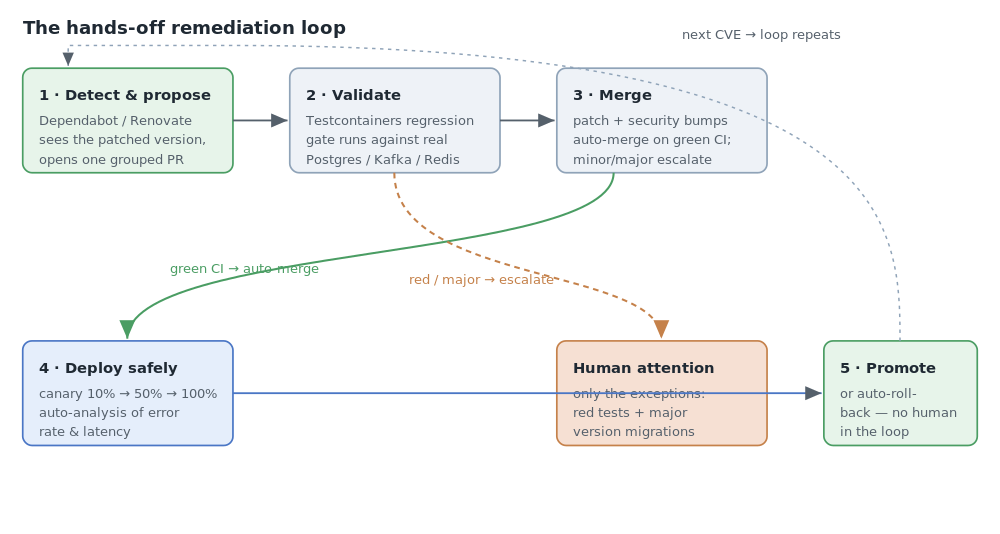
Before the individual pieces, here is the whole loop. Each stage exists to let the safe changes through automatically and surface only the ones that genuinely need a human.
Part 1: Dependabot for Spring Boot parent POMs
Dependabot is the lowest-friction starting point because it is GitHub-native: no external service, no extra credentials, just a config file in your repository. Drop the following into .github/dependabot.yml. The key decisions are the grouping rules — they collapse what would otherwise be a flood of individual PRs into a handful of reviewable ones.
# .github/dependabot.yml
version: 2
updates:
  - package-ecosystem: "maven"
    directory: "/"
    schedule:
      interval: "weekly"
      day: "monday"
    open-pull-requests-limit: 10
    # Label everything so the test pipeline and reviewers can filter
    labels:
      - "dependencies"
      - "java"
    groups:
      # One PR for the entire Spring Boot / Spring ecosystem bump.
      # Keeps the BOM-managed versions moving together as a tested unit.
      spring-ecosystem:
        patterns:
          - "org.springframework*"
          - "org.springframework.boot*"
          - "org.springframework.cloud*"
        update-types:
          - "minor"
          - "patch"
      # Security patches across everything else, grouped into one PR.
      security-patches:
        applies-to: security-updates
        patterns:
          - "*"
      # Routine patch-level bumps for non-Spring libraries.
      minor-and-patch:
        patterns:
          - "*"
        exclude-patterns:
          - "org.springframework*"
        update-types:
          - "minor"
          - "patch"
    # Major bumps stay ungrouped and individual - they need human eyes.
    ignore:
      - dependency-name: "*"
        update-types: ["version-update:semver-major"]
What this configuration buys you:
- The Spring ecosystem moves as one PR. When Spring Boot ships a patch release, you get a single PR that bumps the parent/BOM — exactly the unit-move proven in the section above — rather than a dozen PRs for individually managed artifacts.
- Security updates are isolated. The
applies-to: security-updatesgroup means CVE-driven bumps arrive in their own clearly-labelled PR, so you can fast-track them. - Majors are deliberately excluded. Major version jumps (Spring Boot 3 → 4, Hibernate 6 → 7) are migrations, not patches. See the Spring Boot 3 to 4 Migration Guide for what that work actually involves.
Grouping across multiple services (2026 update)
If you keep several Spring Boot services in a monorepo, Dependabot historically opened a separate PR per directory for the same dependency. As of February 2026, Dependabot can group updates by dependency name across multiple directories, consolidating a single library bump into one PR no matter how many services it touches:
# Monorepo: one PR per dependency, across every service directory
version: 2
updates:
  - package-ecosystem: "maven"
    directories:
      - "/services/orders"
      - "/services/payments"
      - "/services/inventory"
    schedule:
      interval: "weekly"
    groups:
      spring-ecosystem:
        patterns:
          - "org.springframework*"
        update-types:
          - "minor"
          - "patch"
Part 2: Renovate as the power alternative
Dependabot is the easy on-ramp. Once your fleet grows, or once you want finer control — automerge policies, a review dashboard, smarter BOM handling, custom managers for non-standard files — Renovate is the more capable tool. It runs as a GitHub App (or self-hosted), understands Maven BOMs natively, and gives you a Dependency Dashboard issue that shows every pending update in one place.
// renovate.json
{
  "$schema": "https://docs.renovatebot.com/renovate-schema.json",
  "extends": [
    "config:recommended",
    ":dependencyDashboard"
  ],
  "schedule": ["before 6am on monday"],
  "labels": ["dependencies", "java"],
  "packageRules": [
    {
      "description": "Group the whole Spring ecosystem into one PR",
      "matchPackagePrefixes": [
        "org.springframework",
        "org.springframework.boot",
        "org.springframework.cloud"
      ],
      "groupName": "spring ecosystem",
      "matchUpdateTypes": ["minor", "patch"]
    },
    {
      "description": "Auto-merge patch-level bumps once CI is green",
      "matchUpdateTypes": ["patch"],
      "automerge": true,
      "automergeType": "pr",
      "platformAutomerge": true
    },
    {
      "description": "Never auto-merge majors - route them to the dashboard",
      "matchUpdateTypes": ["major"],
      "dependencyDashboardApproval": true
    }
  ],
  "vulnerabilityAlerts": {
    "labels": ["security"],
    "automerge": true
  }
}
The two features that make Renovate worth the extra setup for Spring shops:
- Intelligent BOM handling. When Renovate detects a BOM update, it raises a single PR that moves the BOM version — the managed dependencies follow automatically, exactly the unit-move behaviour proven earlier.
- Tiered automerge. The config above auto-merges patch releases and security fixes the moment CI passes, while routing major bumps to the dashboard for human approval. That is the core of a hands-off remediation loop — provided your test gate is strong enough to trust, which is the next section.
Dependabot vs Renovate: which to choose
| Factor | Dependabot | Renovate |
|---|---|---|
| Setup | One YAML file, GitHub-native, zero credentials | Install GitHub App or self-host |
| Grouping | Good (group rules, multi-directory since 2026) | Excellent (package rules, presets) |
| BOM awareness | Bumps the parent/BOM version you point it at | Native BOM detection and single-PR updates |
| Automerge | Via separate GitHub Actions workflow | Built-in, per-update-type policies |
| Review surface | Individual PRs | PRs + a single Dependency Dashboard issue |
| Best for | Teams starting out, single-repo services | Large fleets, monorepos, hands-off automerge |
Recommendation: start with Dependabot to get value this week. Graduate to Renovate when you want automerge and a dashboard across many repositories. Do not run both on one repo — you will get duplicate PRs.
Part 3: The test gate – regression testing with Testcontainers
Automated PRs are worthless — dangerous, even — without an automated way to decide whether each bump is safe. Unit tests are not enough: the bumps most likely to break you are framework and infrastructure libraries (the database driver, the JPA provider, the message-broker client, the HTTP layer), and their behaviour only surfaces against real backing services. That is exactly what Testcontainers exists for — it spins up real PostgreSQL, Kafka, or Redis containers during the test run, so a dependency bump is validated against the same software it will face in production.
// An integration test that actually exercises the upgraded driver/JPA stack
@SpringBootTest
@Testcontainers
class OrderRepositoryIT {

    @Container
    @ServiceConnection // Spring Boot 3.1+ wires the datasource automatically
    static PostgreSQLContainer<?> postgres =
            new PostgreSQLContainer<>("postgres:16-alpine");

    @Autowired
    OrderRepository orders;

    @Test
    void persistsAndQueriesAgainstRealPostgres() {
        Order saved = orders.save(new Order("SKU-123", 2));

        // A native query or fetch semantic that a Hibernate patch could quietly change
        List<Order> found = orders.findBySku("SKU-123");

        assertThat(found).hasSize(1);
        assertThat(found.get(0).getQuantity()).isEqualTo(2);
    }
}
This is the gate the earlier BOM demo motivates: the Hibernate 6.5.3 → 6.6.4 jump that rode along with the parent bump is precisely the kind of change a query-level integration test catches and a unit test does not. Wire the suite to run on every bot PR and block the merge if anything regresses. The workflow below keys off the dependencies label your bot applies, runs the integration suite against Testcontainers, and only then becomes eligible for automerge.
# .github/workflows/dependency-regression.yml
name: Dependency Regression Gate

on:
  pull_request:
    branches: [ main ]

jobs:
  regression:
    # Only spend CI minutes on dependency PRs from the bot
    if: contains(github.event.pull_request.labels.*.name, 'dependencies')
    runs-on: ubuntu-latest
    steps:
      - uses: actions/checkout@v4
      - uses: actions/setup-java@v4
        with:
          java-version: '21'
          distribution: 'temurin'
          cache: 'maven'

      # Docker is pre-installed on ubuntu-latest - Testcontainers works out of the box
      - name: Full regression suite (unit + integration)
        run: mvn verify --batch-mode

      - name: Publish test results
        uses: EnricoMi/publish-unit-test-result-action@v2
        if: always()
        with:
          files: |
            target/surefire-reports/**/*.xml
            target/failsafe-reports/**/*.xml
Make this workflow a required status check on main. With that in place, Renovate’s automerge (or a Dependabot automerge action) can only complete after the full regression suite passes against real backing services — which is the entire basis for trusting an unattended pipeline. For the broader pipeline patterns this builds on (caching, parallel stages, coverage gates), see Running JUnit 6 Tests in CI/CD Pipelines.
Part 4: Canary deployments for minor framework bumps
Even a green test suite cannot catch everything. Performance regressions, memory-footprint changes, connection-pool behaviour, subtle serialization differences — these slip through tests and only reveal themselves under production traffic. For minor framework bumps (not just patches), the safety net is a canary deployment: route a small slice of live traffic to the upgraded version, watch the metrics, and promote or roll back automatically.
On Kubernetes, Argo Rollouts expresses this declaratively. The canary below sends 10% of traffic to the new version, pauses for an automated analysis of error rate and latency, steps up to 50%, and only then promotes — rolling back automatically if the analysis fails.
# Argo Rollouts: canary strategy for a Spring Boot service
apiVersion: argoproj.io/v1alpha1
kind: Rollout
metadata:
  name: orders-service
spec:
  replicas: 6
  strategy:
    canary:
      steps:
        - setWeight: 10
        - pause: { duration: 5m }
        - analysis:
            templates:
              - templateName: error-rate-and-latency
        - setWeight: 50
        - pause: { duration: 10m }
        - setWeight: 100
  selector:
    matchLabels:
      app: orders-service
  template:
    metadata:
      labels:
        app: orders-service
    spec:
      containers:
        - name: orders-service
          image: registry.example.com/orders-service:3.4.1
          # Spring Boot Actuator exposes the metrics the analysis reads
          readinessProbe:
            httpGet:
              path: /actuator/health/readiness
              port: 8080
# AnalysisTemplate: auto-rollback if the canary degrades
apiVersion: argoproj.io/v1alpha1
kind: AnalysisTemplate
metadata:
name: error-rate-and-latency
spec:
metrics:
- name: error-rate
interval: 1m
# Fail the canary if 5xx rate exceeds 1%
successCondition: result < 0.01
failureLimit: 2
provider:
prometheus:
address: http://prometheus.monitoring:9090
query: |
sum(rate(http_server_requests_seconds_count{app="orders-service",status=~"5.."}[2m]))
/
sum(rate(http_server_requests_seconds_count{app="orders-service"}[2m]))The Prometheus query reads the http_server_requests_seconds_count metric that Spring Boot Actuator with Micrometer exposes out of the box, so no application change is needed to make a service canary-ready. If you are moving to the OTLP export path in Boot 4, the same metric is available — see the Micrometer to OpenTelemetry guide.
Putting it together: the full remediation pipeline
Each part reinforces the next — the loop from the diagram above, spelled out for a routine CVE patch:
- Detect & propose. Dependabot or Renovate sees the patched version and opens a grouped, labelled PR — usually within hours of disclosure.
- Validate. The regression gate runs the full unit + Testcontainers integration suite against real backing services. Red means the PR waits for a human; green means it is eligible to merge.
- Merge. Patch-level and security bumps automerge on green CI. Minor bumps merge after a quick human glance; majors are excluded entirely and planned separately.
- Deploy safely. A canary rollout shifts a slice of production traffic to the new build, watches error rate and latency, and promotes or auto-rolls-back without human intervention.
- Escalate the exceptions. Humans spend their attention only on the failures — the test reds and the major migrations — instead of rubber-stamping the boring 95%.
That inversion is the whole point. The AI scanners flooding your queue are not the problem to fight; they are free labour, as long as you build the gates that let the safe changes through automatically and surface only the ones that genuinely need you.
An AI prompt to audit your dependency automation
Paste this into Claude, ChatGPT, Gemini, or Cursor with your repository in context. It is tuned to the specific pitfalls above, not generic “keep my dependencies updated” advice.
You are auditing a Java/Spring repository for an automated dependency-patching
pipeline (Dependabot or Renovate + a Testcontainers regression gate + canary
deploys). Scan the project and report, in this order:

1. BOM DISCIPLINE: does the build inherit spring-boot-starter-parent or import
   spring-boot-dependencies? Flag every <properties> entry that overrides a
   Spring-managed version in isolation (e.g. jackson-bom.version, netty.version,
   tomcat.version). For each, report file:line and whether it looks like a
   temporary CVE pin (has a comment/reason) or an untracked drift that creates
   an untested combination.

2. BOT CONFIG: is there a .github/dependabot.yml or renovate.json? Check that
   the Spring ecosystem is grouped into one PR, security updates are isolated,
   and semver-major updates are excluded from automerge. Report what is missing.

3. TEST GATE: is there an integration suite using Testcontainers, and a CI
   workflow that runs it on PRs labelled 'dependencies' as a required status
   check? Flag automerge configured WITHOUT a required integration gate - that
   is how silent regressions reach production.

4. RISKIEST BUMPS: list the managed libraries whose behaviour is most likely to
   change across a minor bump (Hibernate/JPA, the JDBC driver, Jackson, the
   servlet container, the message-broker client) and whether each has a
   real-service integration test covering it.

5. DEPLOY SAFETY: is there a canary/progressive-delivery config (Argo Rollouts,
   Flagger) reading Actuator/Micrometer metrics for auto-rollback?

For each finding give file:line and the exact fix. End with a prioritized
rollout plan: what to automate first, and what to keep human-gated.
Frequently asked questions (FAQs)
Should I let the bot override individual Spring-managed dependency versions?
Generally no. The dependency-model section above shows why with real output: overriding one managed version in isolation (Jackson pinned to 2.15.0 under the 3.4.1 parent) leaves the rest of the stack at its tested versions, producing a combination Spring never tested. Configure your bot to bump the parent/BOM as a unit, and only pin an individual managed version when a CVE fix lands ahead of the next Spring Boot release — then remove the override once the BOM catches up.
Is it safe to auto-merge dependency PRs without a human review?
For patch-level and security updates, yes — but only if your test gate is strong enough to trust. That means a required CI check that runs your full integration suite against real backing services via Testcontainers, not just unit tests. Auto-merging on a weak test suite is how silent regressions reach production. Keep minor and major updates out of the automerge path until you have confidence in your coverage.
How do I stop the bot from opening major-version PRs I am not ready for?
In Dependabot, add an ignore rule for version-update:semver-major as shown above. In Renovate, set dependencyDashboardApproval: true for major update types so they appear on the dashboard but are not raised as PRs until you tick the box. Major bumps such as Spring Boot 3 → 4 are migrations with breaking changes — treat them as planned work, not patches.
Do I need both Dependabot and Renovate?
No — pick one. Running both on the same repository produces duplicate PRs. Start with Dependabot for its zero-setup, GitHub-native simplicity. Move to Renovate when you want built-in automerge policies, a single Dependency Dashboard across many repos, or its smarter BOM and custom-manager handling for large fleets.
Will Testcontainers work in my CI runners?
On GitHub Actions’ ubuntu-latest runners, Docker is pre-installed and Testcontainers works with no extra setup. On Jenkins or self-hosted runners you typically set TESTCONTAINERS_RYUK_DISABLED=true and ensure the Docker socket is reachable. See Running JUnit 6 Tests in CI/CD Pipelines for the per-platform Testcontainers configuration.
How can I reproduce the dependency:tree results in this article?
Create a minimal Maven project with the spring-boot-starter-parent at 3.3.5 and the web + data-jpa starters, then run mvn -B dependency:tree. Change only the parent <version> to 3.4.1 and run it again — the managed versions move together. Resolution only reads POMs, so any JDK that runs Maven produces the same resolved versions shown here.
See also
- Spring Boot 3 to 4 Migration Guide: What Actually Breaks
- Running JUnit 6 Tests in CI/CD Pipelines (GitHub Actions, Jenkins)
- Spring Framework 6 to 7 Migration Guide
- Micrometer to OpenTelemetry: The Spring Boot 4 Observability Guide
- Spring Cloud Netflix to Modern Alternatives: The Complete Migration Guide
Conclusion
The wave of AI-driven patch requests is not going to slow down, and trying to keep up by reviewing faster is a losing game. The sustainable answer is a pipeline: let Dependabot or Renovate open grouped, BOM-aware PRs; let a Testcontainers-backed regression suite decide which ones are safe; auto-merge the boring majority on green CI; and let canary deployments catch the rare regression that slips past your tests. The foundation under all of it is the one behaviour proven at the top of this guide — bump the parent as a unit, never drift a single managed version by accident. Build those gates once and dependency patching stops being a queue you fight and becomes a system that mostly runs itself, leaving you to spend your attention on the upgrades that actually deserve it.
No Comments yet!