
Whether you are preparing for a technical interview or exploring the fascinating world of number theory, encountering Pronic numbers is almost a rite of passage for Java developers. These numbers, often hidden in pattern-matching puzzles, have unique properties that make them a favorite for practicing algorithmic efficiency.
In this guide, we will dive deep into what Pronic numbers are and demonstrate two distinct ways to identify them using Java—ranging from a beginner-friendly loop to a high-performance mathematical “trick.”
What is a Pronic Number?
A Pronic number (also known as an oblong or rectangular number) is a number that is the product of two consecutive integers. Mathematically, a number P is pronic if it can be expressed as:
P = n X (n + 1)
For some integer n.
Examples of Pronic Numbers:
- 0: 0 X 1 = 0
- 2: 1 X 2 = 2
- 6: 2 X 3 = 6
- 12: 3 X 4 = 12
- 20: 4 X 5 = 20
The Mathematical Secret
If we rearrange the equation P = n(n+1), we get a quadratic equation: n2 + n – P = 0. Using the quadratic formula to solve for n:
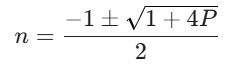
For n to be a valid integer, the term inside the square root (1 + 4P) must be a perfect square. This insight allows us to move beyond simple loops and into the realm of constant-time complexity.
Method 1: The Brute-Force Approach (Iterative)
The most intuitive way to check for a Pronic number is to iterate through integers and check their products. Since n X (n+1) is roughly n2, we only need to check up to the square root of the input number.
Java Implementation
public class PronicChecker {
    public static boolean isPronicBrute(int num) {
        if (num < 0) return false;

        for (int i = 0; i * i <= num; i++) {
            if (i * (i + 1) == num) {
                return true;
            }
        }
        return false;
    }

    public static void main(String[] args) {
        int[] tests = {0, 2, 6, 7, 12, 20, 110, 111};
        System.out.println("--- Brute Force Approach ---");
        for (int n : tests) {
            System.out.println("Is " + n + " Pronic? " + isPronicBrute(n));
        }
    }
}
Expected Output
--- Brute Force Approach ---
Is 0 Pronic? true
Is 2 Pronic? true
Is 6 Pronic? true
Is 7 Pronic? false
Is 12 Pronic? true
Is 20 Pronic? true
Is 110 Pronic? true
Is 111 Pronic? false
Method 2: The Optimized Square-Root Trick
If you are dealing with large datasets or performance-critical applications, O(√n) might be too slow. We can determine if a number is pronic in constant time by checking if 1 + 4P is a perfect square.
Java Implementation
public class PronicCheckerOptimized {
    public static boolean isPronic(int num) {
        if (num < 0) return false;

        // Calculate the discriminant: 1 + 4*P
        // We use 4L to force 'long' arithmetic and prevent integer overflow
        long discriminant = 1 + 4L * num;
        long sqrt = (long) Math.sqrt(discriminant);

        // Check if it's a perfect square
        return (sqrt * sqrt == discriminant);
    }

    public static void main(String[] args) {
        int[] tests = {0, 2, 6, 7, 12, 20, 110, 111};
        System.out.println("--- Optimized Approach ---");
        for (int n : tests) {
            System.out.println("Is " + n + " Pronic? " + isPronic(n));
        }
    }
}
Expected Output
--- Optimized Approach ---
Is 0 Pronic? true
Is 2 Pronic? true
Is 6 Pronic? true
Is 7 Pronic? false
Is 12 Pronic? true
Is 20 Pronic? true
Is 110 Pronic? true
Is 111 Pronic? false
Summary & Comparison
| Feature | Brute-Force | Optimized (Square Root) |
| Time Complexity | O(√n) | O(1) |
| Space Complexity | O(1) | O(1) |
| Overflow Risk | None | Low (easily fixed with long) |
| Best For | Learning/Small Inputs | Production/High Performance |
Real-World Applications
Pronic numbers aren’t just for math class! They appear in:
- Tile Arrangements: Calculating rectangular grids where one side is one unit longer than the other.
- Algorithm Trivia: Frequent interview questions used to test a developer’s ability to optimize a loop into a mathematical formula.
- Number Theory: Identifying special product sequences and properties of even integers.
Final Thoughts
For most Java applications, the Optimized Approach is the way to go. It is faster, cleaner, and handles larger integers more gracefully. By encapsulating this logic into a small utility method, you can keep your codebase readable and efficient.
No Comments yet!