
We had a callback that “audited every save” — except it silently skipped about half of them. The @PreUpdate on the AuditListener ran correctly for every web-layer save. It never ran for the nightly batch job. The batch used HQL bulk updates. Nobody remembered that bulk operations bypass the persistence context entirely, so lifecycle callbacks never fire for them. The audit log looked complete. It was missing six months of batch changes.
That is bug four in this list. Here are all five, each one a real failure mode with the code that produces it and the fix.
Technical Note: JPA vs. Hibernate Behavior
It is important to distinguish that all annotations discussed in this guide (like @PrePersist, @PostUpdate, etc.) are defined by the Jakarta Persistence API (JPA) specification. Hibernate 7 serves as the implementation provider. While the API is standard, specific behaviors such as dirty checking algorithms, the exact timing of the flush, and session state transitions are governed by Hibernate-specific logic.
The Problem: Fragmented Business Logic
In many legacy applications, developers scatter logic like password encryption, audit logging, and data normalization across various controllers and services.
The Agitation: This leads to “leaky abstractions.” If you forget to call setUpdatedAt(LocalDateTime.now()) in just one of your ten update methods, your data loses integrity. Searching for where a specific field was modified becomes a needle-in-a-haystack problem. Furthermore, manually managing these fields increases the cognitive load on developers, making the codebase harder to onboard and more prone to “human error” during rapid feature development.
The Solution: Hibernate Lifecycle Callbacks allow you to attach logic directly to the entity’s journey—from being a transient object to a managed, detached, or removed state. By moving this logic to the entity level, you guarantee that no matter which service modifies the data, the integrity rules are always applied.
Visualizing the Entity Lifecycle and Callback Hooks
Understanding the state transitions is the most critical part of mastering Hibernate. Here is a visual representation of how an entity moves through its lifecycle and where the callback hooks sit:
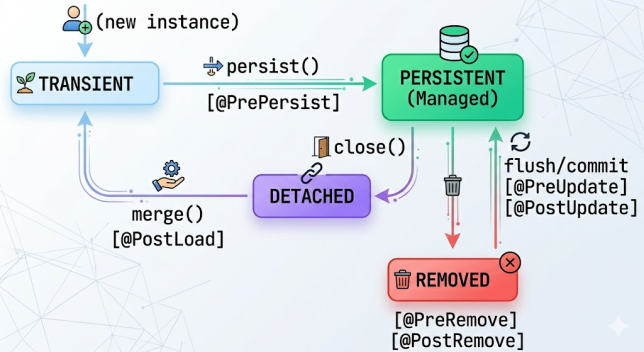
The Four States Explained:
- Transient: The object is a fresh
newinstance. It has no representation in the database and is not yet associated with an active Hibernate Session. - Persistent (Managed: The object is associated with an active Session and has an identifier (Primary Key). Hibernate tracks every change made to this object and will “flush” these changes to the database at the end of the transaction.
- Detached: The object has a database identity, but the Session it was associated with has been closed or the object was explicitly evicted. Changes made here aren’t tracked until the object is re-merged.
- Removed: The object is still managed by the session but has been scheduled for deletion from the database.
1. Internal Callbacks (@PrePersist, @PostUpdate, etc.)
The simplest way to implement callbacks is by annotating methods directly within your @Entity class. Hibernate 7 continues to support the JPA standard annotations, providing a seamless bridge between your Java code and database triggers.
Implementation Example: The Comprehensive Audit Pattern
Let’s create a Product entity that not only manages timestamps but also handles data normalization (like trimming strings) before saving.
import jakarta.persistence.*;
import java.time.LocalDateTime;

@Entity
@Table(name = "products")
public class Product {

    @Id
    @GeneratedValue(strategy = GenerationType.IDENTITY)
    private Long id;

    private String name;

    private Double price;

    @Column(name = "created_at", updatable = false)
    private LocalDateTime createdAt;

    @Column(name = "updated_at")
    private LocalDateTime updatedAt;

    // --- Lifecycle Callbacks ---

    @PrePersist
    protected void onCreate() {
        this.createdAt = LocalDateTime.now();
        this.updatedAt = LocalDateTime.now();
        if (this.name != null) {
            this.name = this.name.trim();
        }
    }

    @PreUpdate
    protected void onUpdate() {
        this.updatedAt = LocalDateTime.now();
    }

    @PostPersist
    protected void afterSave() {
        // Post-save logic (e.g., logging or notifications)
    }

    // Getters and Setters...
}
Production Tip: Logging in Callbacks
While System.out.println() is helpful for local debugging, always use a structured logger (like SLF4J with Logback) in production environments. Additionally, avoid excessive logging inside callbacks—since these fire for every entity operation, high-volume logging can lead to disk I/O bottlenecks and increased latency in your DB transactions.
Bug 1: Calling EntityManager from Inside a Callback
The most tempting misuse: you want to log the change to a separate AuditLog entity, so you inject EntityManager and call em.persist(auditEntry) inside @PostPersist.
@PostPersist
public void auditSave(Product product) {
    AuditLog log = new AuditLog(product.getId(), "CREATED");
    entityManager.persist(log);  // TransactionRequiredException or recursive flush
}
In Hibernate 7, the callback fires during the flush cycle. Calling persist() inside the flush adds a new operation to the action queue, which can trigger a second flush, which fires callbacks again. You get either a TransactionRequiredException, a recursive flush, or both. The fix is to collect audit entries during the operation and persist them after the primary transaction commits — via a Spring @TransactionalEventListener(phase = AFTER_COMMIT).
Bug 2: @PreUpdate Doesn’t Fire for HQL/JPQL Bulk Updates
This is the audit gap from the opening story. Bulk DML in HQL translates directly to SQL without touching the persistence context.
// @PreUpdate on Product never fires for this
em.createQuery("UPDATE Product p SET p.price = p.price * 1.1 WHERE p.category = :cat")
  .setParameter("cat", "Electronics")
  .executeUpdate();
No entity is loaded into the persistence context. No dirty checking runs. No callbacks fire. If your audit trail depends on @PreUpdate, bulk operations silently produce an incomplete record. The fix for audit coverage: either load and update entities individually (expensive but complete), or write the audit log entry at the service layer before the bulk DML runs.
Bug 3: @PostLoad and Lazy Fields — the Hidden Initialisation
@PostLoad fires after the entity is fully loaded. If your entity has lazy associations and the @PostLoad method accesses one of them, you are initialising those associations on every load.
@PostLoad
public void computeDisplayName() {
    // tags is a lazy @OneToMany collection
    this.displayTag = tags.stream()
        .filter(Tag::isPrimary)
        .findFirst()
        .map(Tag::getName)
        .orElse("general");  // triggers SELECT on tags collection
}
Every find() or JPQL query that returns this entity now also fires a SELECT on tags. In a list endpoint returning 50 products, that is 50 extra queries — a N+1 hidden in a callback. Fix: use a scalar column or a @Formula for derived display values, or ensure tags is JOIN FETCHed in queries where displayTag is needed.
Bug 4: Using Callbacks for Cross-Aggregate Side Effects
Saving an Order triggers @PostPersist, which updates InventoryItem.reservedCount. Updating inventory in the same callback means every order save touches the inventory table, adds a second entity to the flush cycle, and creates a hidden ordering dependency between two aggregates.
@PostPersist
public void reserveInventory(Order order) {
    for (OrderItem item : order.getItems()) {
        InventoryItem inv = inventoryRepo.findBySku(item.getSku());
        inv.setReservedCount(inv.getReservedCount() + item.getQuantity());
        // This fires another flush, another @PreUpdate on InventoryItem, cascade risk
    }
}
If inventory update fails, the order is already persisted. You have a partial state. Callbacks don’t participate in the same unit-of-work contract in the way a service method does. Cross-aggregate side effects belong in a domain service or an event listener that runs after commit — not in a persistence callback.
Bug 5: Spring @Autowired in an Entity Callback
Entity classes are not Spring beans. Spring does not manage their lifecycle, so @Autowired fields in an entity are null at runtime.
@Entity
public class Order {
    @Autowired  // always null — Spring does not inject into entity instances
    private NotificationService notificationService;

    @PostPersist
    public void notifyOnSave() {
        notificationService.send(...);  // NullPointerException
    }
}
The correct pattern is to move the callback to an @EntityListeners class that is a Spring component — but that requires extra configuration because Hibernate also does not inject Spring beans into listener classes by default. The solution: use a BeanFactory holder or configure Spring’s HibernateJpaVendorAdapter to wire the listener through the EntityManagerFactory. Alternatively, skip the callback for side effects entirely and use a Spring @TransactionalEventListener instead.
When to Use Callbacks vs Envers vs an EventListener
| Need | Right tool |
|---|---|
| Timestamp fields (createdAt, updatedAt) | @PrePersist / @PreUpdate in @MappedSuperclass |
| Derived/computed @Transient field after load | @PostLoad (scalar fields only, no lazy associations) |
| Full field-level change history with rollback | Hibernate Envers (@Audited) |
| Cross-aggregate side effects after commit | @TransactionalEventListener(phase = AFTER_COMMIT) |
| Audit that must cover bulk HQL operations | Service-layer logging before the bulk DML |
2. Global Reusability with @EntityListeners
Defining callbacks inside every entity violates the DRY (Don’t Repeat Yourself) principle. As your project scales to 50+ entities, you don’t want to copy-paste the same onCreate and onUpdate methods. Hibernate 7 allows you to move this logic to a separate Listener class.
Step 1: Define a Base Interface
To make your listener type-safe, define an interface that all auditable entities must implement.
public interface Auditable {
    void setCreatedAt(LocalDateTime date);
    void setUpdatedAt(LocalDateTime date);
}
Step 2: Create the Centralized Listener
public class AuditListener {

    @PrePersist
    public void setCreatedOn(Object entity) {
        if (entity instanceof Auditable auditable) {
            LocalDateTime now = LocalDateTime.now();
            auditable.setCreatedAt(now);
            auditable.setUpdatedAt(now);
        }
    }

    @PreUpdate
    public void setUpdatedOn(Object entity) {
        if (entity instanceof Auditable auditable) {
            auditable.setUpdatedAt(LocalDateTime.now());
        }
    }
}
3. Deep Dive: The Full Callback Table
| Annotation | Description | Best Use Case |
@PrePersist | Before EntityManager.persist() is flushed. | Setting IDs, default values, or creation dates. |
@PostPersist | After the database INSERT. | Logging, sending emails, or starting async tasks. |
@PreUpdate | Before the database UPDATE. | Updating “last modified” timestamps. |
@PostUpdate | After the database UPDATE. | Clearing caches or audit trail logging. |
@PreRemove | Before the database DELETE. | Dependency checks or cascading logic manually. |
@PostRemove | After the database DELETE. | Deleting associated files from disk/S3. |
@PostLoad | After an entity is retrieved from DB. | Decrypting data or calculating transient fields. |
When NOT to Use Callbacks (Architectural Boundaries)
While lifecycle events are powerful, they are not a silver bullet for all business logic. Overusing them can lead to “hidden side effects” that are difficult to trace.
Avoid Callbacks for:
- Complex Workflows: If saving a
Usertriggers a complex 5-step onboarding sequence involving three other microservices, do not put this in@PostPersist. Use an Event Bus or Messaging system (like RabbitMQ or Kafka). - Cross-Aggregate Logic: If updating an
Orderrequires recalculating the total stock of five differentWarehouseentities, this logic belongs in a Domain Service, not an entity callback. Callbacks should ideally only modify the state of the entity they are attached to. - Multi-Entity Orchestration: Lifecycle events lack the context of “why” a change is happening. If an entity is being updated as part of a bulk batch job vs. a high-priority user request, the callback cannot easily distinguish between the two.
The “Hard Rules” for Production Success
To ensure your persistence layer remains predictable and high-performing, you must treat these rules as non-negotiable architectural constraints.
❌ What to NEVER Do:
- No Database Queries: Never execute
session.createQuery()orentityManagercalls inside a callback. This can trigger additional flushes, leading to infinite recursion, data inconsistency, or the dreadedStackOverflowError. If you need to check other records, do it in the service layer before calling Hibernate. - No Remote API Calls: Callbacks run inside the database transaction thread. Calling an external REST API (like Stripe or Twilio) inside a callback will hang your DB connection until the API responds. This significantly increases transaction time and can quickly exhaust your connection pool, leading to a total system outage.
- No State Changes in @PostXXX: Once a
@PostUpdateor@PostPersistis triggered, the data has already been synchronized with the database. Modifying the entity’s fields here is effectively invisible to the database unless you trigger a second, manual update operation. This is a massive performance anti-pattern and often leads to “lost update” bugs.
✅ What to ALWAYS Do:
- Keep Callbacks Idempotent: Ensure that if a callback is triggered multiple times for the same logical operation, the outcome remains consistent. This prevents side effects during transaction retries or complex merge operations.
- Prefer Listeners over Entity Methods: Move your logic to
@EntityListeners. This keeps your@Entityclasses as clean, readable POJOs and allows you to unit test the listener logic independently of the database. - Keep Logic Lightweight: Callbacks should be restricted to simple field assignments, data normalization (like trimming strings), or lightweight internal flag setting. Anything requiring significant CPU cycles or external resources belongs in the application service layer.
Potential Pitfalls and Edge Cases
- The “Ghost” Update: If your
@PreUpdatelogic modifies a field every time (even if it’s just a timestamp), it might trigger a SQL UPDATE even if no other business-relevant data changed. In high-traffic systems, this can double your database write load. - Inheritance Complications: Callbacks are inherited from
@MappedSuperclassor parent entities. If you have a deep hierarchy, ensure your logic is generic enough to handle different child types or useinstanceofchecks to avoid casting exceptions. - Bulk Operations Bypass: It is critical to remember that
HQL,JPQL, orCriteriabulk updates/deletes (e.g.,UPDATE Product p SET p.price = p.price * 1.1) do not trigger lifecycle callbacks. These operations translate directly to SQL and bypass the persistence context entirely, meaning yourupdatedAtfields or audit logs will not fire.
Frequently Asked Questions (FAQ)
Q1: What is the difference between @PrePersist and @PreUpdate?
@PrePersist is triggered exclusively during the initial SQL INSERT. @PreUpdate is triggered when an existing, managed entity is found to be “dirty” during a flush. If you haven’t modified any fields, @PreUpdate will not fire.
Q2: Can I use multiple listeners on a single entity?
Yes, the @EntityListeners annotation accepts an array (e.g., @{AuditListener.class, ValidationListener.class}). Hibernate executes them in the exact order they are declared in the array, allowing you to chain logic.
Q3: Why is @PostLoad useful for non-persistent data?
It is the perfect hook for “computed” or “transient” fields. For example, if you store a user’s dateOfBirth, you can use @PostLoad to calculate their current age and populate a @Transient field, ensuring the UI always has access to derived data without storing it redundantly.
Q4: Do callbacks work with Hibernate’s StatelessSession?
No. A StatelessSession operates at a much lower level and does not maintain a persistence context or track entity states. Consequently, all JPA lifecycle annotations and listeners are completely ignored in this mode. If you need auditing in a batch job using StatelessSession, implement the logic manually in your service layer or use a database-level trigger.
Q5: Will lifecycle callbacks fire during a Spring Data JPA save() call?
Yes. Spring Data JPA’s repository.save() delegates to EntityManager.persist() for new entities and EntityManager.merge() for existing ones — both trigger the appropriate callbacks. This is why using @PrePersist and @PreUpdate for timestamping is better than manual field-setting in service methods: the logic fires automatically regardless of which Spring Data method triggered the save.
If you’re designing a production-grade persistence layer or preparing for senior Java interviews, mastering lifecycle callbacks is non-negotiable.
Further Reading: For a deep dive into advanced session handling, refer to the Official Hibernate Documentation or check out this community guide on Entity Lifecycle Callbacks.
Found this guide helpful? For more technical deep-dives into Java Persistence and Hibernate 7, visit ankurm.com.
AI Prompts You Can Use
Prompt 1: Add Audit Fields Using Lifecycle Callbacks
What it does: Generates a reusable @MappedSuperclass with createdAt, updatedAt, and createdBy fields populated automatically via @PrePersist and @PreUpdate, so every entity that extends it gets audit tracking for free.
When to use it: Adding audit columns to multiple entities without duplicating callback logic in each one.
Create a Hibernate 7 @MappedSuperclass called AuditableEntity with: createdAt (Instant, set in @PrePersist), updatedAt (Instant, updated in @PreUpdate), and createdBy (String, read from a SecurityContext or ThreadLocal in @PrePersist). Make it abstract and show how to extend it in a concrete entity. Use jakarta.persistence annotations throughout.Prompt 2: Debug @PostLoad Not Firing for Lazily Loaded Associations
What it does: Explains why @PostLoad sometimes does not trigger for lazily-loaded proxy objects and collections, and shows the correct pattern for initialising computed fields after load.
When to use it: When a derived field calculated in @PostLoad is always null or stale when the entity is accessed through a lazy proxy.
My Hibernate 7 @PostLoad method is not being called for entities loaded via a lazy association. Entity: [paste entity]. Explain: does @PostLoad fire when a proxy is initialised, or only on direct get()/find()? What is the workaround to ensure my computed field is always initialised? Should I use @Transient + a getter that computes on demand instead?Prompt 3: Implement Change Logging with @PreUpdate
What it does: Uses @PreUpdate to compare the entity’s current state against its persisted snapshot and write a structured audit log entry for every changed field before the UPDATE is executed.
When to use it: Building a field-level change history without adding an external auditing library like Hibernate Envers.
Implement field-level change logging for this Hibernate 7 entity using @PreUpdate: [paste entity]. In the callback, compare each mutable field against its database value (use EntityManager.getEntityManagerFactory().getPersistenceUnitUtil() or a shadow copy held in a @Transient field). Write the changed fields and old/new values to an AuditLog entity that is persisted in a separate transaction.Prompt 4: Validate Entity State in @PrePersist Without a Validator
What it does: Adds business rule validation inside @PrePersist and @PreUpdate callbacks that throws a meaningful exception before the INSERT or UPDATE reaches the database, avoiding constraint violation exceptions from the DB layer.
When to use it: Enforcing invariants that are too complex for @NotNull / @Size annotations, such as cross-field rules or dynamic business logic.
Add @PrePersist and @PreUpdate validation to this Hibernate 7 entity: [paste entity]. Validate: the email field matches a regex, endDate is after startDate, and status is a valid enum value. Throw a meaningful IllegalStateException with a message identifying which rule failed. This must run before the SQL reaches the database.Prompt 5: Implement Soft Delete Using @PreRemove
What it does: Intercepts session.remove() calls via @PreRemove to set a deletedAt timestamp instead of physically deleting the row, combined with a @Where filter that hides soft-deleted records from all queries.
When to use it: When data must be logically deleted but retained for auditing or recovery without changing the calling code.
Implement soft delete for this Hibernate 7 entity using @PreRemove: [paste entity]. The @PreRemove callback should set deletedAt = Instant.now() and then throw an exception or use a flag to cancel the actual DELETE. Add @Where(clause = "deleted_at IS NULL") so all queries automatically exclude deleted records. Also show how to write a native query to permanently purge soft-deleted records older than 90 days.Conclusion
Hibernate Lifecycle Callbacks are one of the most elegant tools in the JPA toolkit — they let you attach infrastructure concerns like auditing, timestamping, and data normalisation directly to the entity, removing scattered boilerplate from your service layer and guaranteeing consistency no matter how the entity is persisted. The key is discipline: keep callbacks lightweight, avoid database queries and remote calls inside them, prefer @EntityListeners for reusable cross-entity logic, and always remember that bulk HQL and MutationQuery operations bypass them entirely. Applied correctly, lifecycle callbacks make your persistence layer self-sufficient, predictable, and far easier to maintain as your application scales.
Further Reading & Cross-References
- 📘 Master the Hibernate 7 Entity Lifecycle — the four entity states that callbacks hook into
- 📘 Hibernate 7 Interceptors — a more powerful, cross-cutting alternative to entity-level callbacks
- 📘 JPA Persistence Annotations — full reference for all Jakarta Persistence mapping annotations
- 📘 Batch Processing with Hibernate 7 — why StatelessSession skips callbacks and when that matters
- 🔗 Official Hibernate 7 User Guide — Events and Interceptors
- 🔗 Jakarta Persistence 3.2 — Entity Listeners and Lifecycle Callbacks
No Comments yet!