
I have had this conversation more than once in the last year: a team ships a chat feature, users start asking it to “just handle” a workflow instead of navigating the UI, and suddenly the question isn’t “how do we improve the chatbot” but “why does our backend have no concept of intent?” The REST API has fifty endpoints, each doing one thing precisely. The agent needs to orchestrate twelve of them, in order, with conditional branching, to do what a human described in one sentence.
That gap — between an API designed for deterministic human clients and one that needs to serve a reasoning agent — is what this post is actually about. Not whether agents will replace CRUD, but what specifically needs to change in your Java backend when the caller is an LLM instead of a browser. All examples here run on Spring Boot 3.4, LangChain4j 0.33.0, Java 21.
What Changed in a Real Inventory Service When We Added Agent Support
We added an agent-accessible layer to an existing Spring Boot inventory service that had been running for three years. Here is what we actually changed — not architecturally in theory, but in the codebase.
Added @Operation descriptions to 14 endpoints. The agent uses the OpenAPI spec to decide which endpoint to call. Before this change, most endpoints had terse summaries like “Get order” — not enough for an LLM to distinguish between GET /orders/{id} (returns full order with line items) and GET /orders/{id}/summary (returns a one-line status string). Adding explicit natural-language descriptions to each reduced tool-calling hallucinations measurably.
Added idempotency keys to every mutating endpoint. Agents retry on failure. Before we added idempotency key support, a network timeout during a POST /purchase-orders call could result in two purchase orders being created. The fix was an X-Idempotency-Key header checked against a Redis cache with a 24-hour TTL.
Added batch read endpoints for three high-frequency lookups. An agent planning a multi-SKU restocking run was making 40+ individual GET /inventory/{sku} calls. We added POST /inventory/batch that accepts a list of up to 100 SKUs and returns all statuses in one query. Agent latency for that workflow dropped from ~40s to ~1.2s.
We did not change the underlying business logic. The Java service layer, the JPA entities, the transaction boundaries — all unchanged. The agent-readiness work was entirely in the API layer and the documentation layer.
The Three Phases of AI in Software Development
Before predicting where we’re going, it helps to map where we’ve been:
| Phase | Example | Role in Architecture | Backend Impact |
|---|---|---|---|
| Phase 1: Copilot | GitHub Copilot, ChatGPT for coding | Developer productivity tool | None — AI lives outside the system |
| Phase 2: Embedded AI | AI-powered search, recommendation APIs | Feature inside the product | New ML endpoints, vector DBs added |
| Phase 3: Autonomous Agent | AI that books meetings, edits files, calls APIs | Actor with agency in the system | Everything changes |
We are entering Phase 3. And Phase 3 doesn’t just add a new endpoint — it questions whether the endpoint model itself is the right abstraction.
What Is an Autonomous AI Agent?
An autonomous agent is an AI system that can: receive a high-level goal in natural language, break it into sub-tasks, call tools/APIs to execute those tasks, observe the results, and adjust its plan accordingly — without a human specifying each step.
// Traditional CRUD flow: human drives every step
// Step 1: POST /orders { productId, quantity }
// Step 2: GET /inventory/{productId}
// Step 3: POST /payments { orderId, amount }
// Step 4: POST /shipments { orderId }

// Agent flow: human provides intent
// "Order 50 units of SKU-123 for the Chicago warehouse,
//  use the preferred supplier, and expedite if stock is below 20."

// The agent figures out which APIs to call, in what order,
// handles failures, and reports back with a summary.
The key difference: in the traditional model, your backend exposes discrete operations. In the agentic model, your backend exposes capabilities that an AI orchestrator assembles into workflows.
Will REST APIs Disappear?
Short answer: No. Longer answer: they will evolve into a two-tier architecture.
Tier 1 — Capability Layer (REST/gRPC remains): Fine-grained, deterministic operations that agents call as tools. GET /inventory/{sku}, POST /orders, PATCH /orders/{id}/cancel. These must be exceptionally well-documented (OpenAPI spec), idempotent where possible, and must return structured responses the LLM can parse without ambiguity.
Tier 2 — Intent Layer (new): A natural-language or structured-intent endpoint that accepts goals and delegates to an agent orchestrator. POST /intent { "goal": "process end-of-quarter supplier payments" }. This is where the AI agent lives.
// IntentController.java - the new Tier 2 endpoint
import org.springframework.http.ResponseEntity;
import org.springframework.security.core.annotation.AuthenticationPrincipal;
import org.springframework.security.core.userdetails.UserDetails;
import org.springframework.web.bind.annotation.*;
import lombok.RequiredArgsConstructor;

import java.util.Map;

@RestController
@RequestMapping("/intent")
@RequiredArgsConstructor
public class IntentController {
    private final AgentOrchestrator orchestrator;
    private final IntentValidator intentValidator;

    // POST /intent
    // Body: { "goal": "Reorder SKU-123 if stock is below 100 units",
    //         "context": { "warehouseId": "CHI-01" } }
    @PostMapping
    public ResponseEntity<AgentResponse> processIntent(
            @RequestBody IntentRequest request,
            @AuthenticationPrincipal UserDetails user) {

        // Validate intent scope against user permissions
        intentValidator.validate(request, user);

        // Dispatch to agent — returns immediately with a job ID
        String jobId = orchestrator.submitGoal(
            request.goal(),
            request.context(),
            user.getUsername()
        );

        return ResponseEntity.accepted()
            .body(new AgentResponse(jobId, "PROCESSING",
                "/intent/status/" + jobId));
    }

    // GET /intent/status/{jobId} - poll for completion
    @GetMapping("/status/{jobId}")
    public ResponseEntity<AgentJobStatus> getStatus(@PathVariable String jobId) {
        return ResponseEntity.ok(orchestrator.getJobStatus(jobId));
    }

    // Webhook registration (optional): client provides callback URL at submission time
    // Agent calls the URL when the job completes instead of polling
}
How the Code Works
- Async job pattern — intent requests return a
jobIdimmediately (HTTP 202 Accepted) because agent execution can take seconds to minutes. Clients poll/intent/status/{jobId}or receive a webhook callback. - Virtual threads (Java 21+) —
Executors.newVirtualThreadPerTaskExecutor()is ideal for agent tasks that spend most of their time waiting on LLM API calls. No thread pool sizing headaches. - Intent validation — critical security layer. An AI agent can call many internal APIs; you must scope what goals a given user/role is allowed to submit before the agent runs.
- Two-tier separation — your existing REST CRUD endpoints stay unchanged in Tier 1. Tier 2 is a thin orchestration wrapper that composes them.
Agent Orchestration vs. Traditional Microservices
| Dimension | Traditional Microservices | Agent Orchestration |
|---|---|---|
| Workflow definition | Hardcoded in code / BPMN | Emergent from LLM reasoning |
| Error handling | Explicit try/catch, circuit breakers | LLM retries with context; needs guardrails |
| Auditability | High — deterministic trace | Lower — must log every LLM decision |
| Flexibility | Low — code change required for new flow | High — new goal = new prompt |
| Cost | CPU/memory | CPU/memory + token cost |
| Latency | Milliseconds | Seconds to minutes |
| Testability | Unit/integration tests | Evaluation frameworks (LLM evals) |
The implication: agents are not a replacement for microservices. They are a coordination layer on top of microservices. The right mental model is: microservices provide reliable, tested, atomic capabilities; agents compose those capabilities dynamically based on intent.
Java-Based Agent Frameworks in 2026
// Option 1: LangChain4j (Most mature Java agent framework)
// Best for: Declarative agents with memory and automatic tool execution
InventoryAgent agent = AiServices.builder(InventoryAgent.class)
    .chatLanguageModel(model)
    .tools(new InventoryTools(), new OrderTools(), new SupplierTools())
    .chatMemory(MessageWindowChatMemory.withMaxMessages(30))
    .build();

// Option 2: Spring AI (Spring-native, high-velocity development)
// Best for: Seamless integration with the Spring ecosystem and simple function calling
ChatClient client = ChatClient.builder(model)
    .defaultFunctions("checkInventory") // Maps to @Bean annotated java.util.function.Function
    .build();

// Option 3: Semantic Kernel for Java (Enterprise-grade from Microsoft)
// Best for: Cross-language compatibility (C#/Python/Java) and complex plugin architectures
Kernel kernel = Kernel.builder()
    .withAIService(ChatCompletionService.class,
        OpenAIChatCompletion.builder()
            .withModelId("gpt-4o")
            .build())
    .build();

KernelPlugin inventoryPlugin = KernelPluginFactory
    .createFromObject(new InventoryFunctions(), "InventoryPlugin");
kernel.importPlugin(inventoryPlugin);

// Option 4: Custom Agent Loop (Full control / Low-level API)
// Best for: Precise tool selection, custom retry logic, or human-in-the-loop approvals
public class CustomAgentLoop {
    private final ChatModel model;

    public String run(String goal, List<Tool> tools, int maxIterations) {
        List<Message> history = new ArrayList<>();
        history.add(new SystemMessage(buildSystemPrompt(tools)));
        history.add(new UserMessage(goal));

        for (int i = 0; i < maxIterations; i++) {
            ChatResponse response = model.call(new Prompt(history));
            AssistantMessage assistantMessage = response.getResult().getOutput();
            history.add(assistantMessage);

            if (response.hasToolCalls()) {
                for (ToolCall call : response.getToolCalls()) {
                    String result = dispatchTool(call, tools);
                    history.add(new ToolResponseMessage(call.id(), result));
                }
                // Continue loop to process tool results and re-query LLM
            } else {
                // No tool calls — LLM has produced the final answer
                return assistantMessage.getContent();
            }
        }
        // Safety net: max iterations reached without a final answer
        return "Agent could not complete the goal within " + maxIterations + " steps.";
    }

    private String dispatchTool(ToolCall call, List<Tool> tools) {
        return tools.stream()
            .filter(t -> t.name().equals(call.name()))
            .findFirst()
            .map(t -> t.execute(call.arguments()))
            .orElse("{"error": "Tool not found: " + call.name() + ""}");
    }

    private String buildSystemPrompt(List<Tool> tools) {
        StringBuilder sb = new StringBuilder(
            "You are an autonomous agent. Use the available tools to complete the user's goal.nnAvailable tools:n");
        tools.forEach(t ->
            sb.append("- ").append(t.name()).append(": ").append(t.description()).append("n"));
        return sb.toString();
    }
}
How the Code Works
- LangChain4j AiServices — the most production-ready option in Java; the framework handles tool dispatching, result injection, and loop termination automatically.
- maxIterations guard — every agent loop must have a hard iteration cap. Without it, a confused LLM can loop indefinitely, burning tokens and potentially causing unintended side effects.
- Custom agent loop — gives you full control over the ReAct (Reasoning + Acting) pattern; use when LangChain4j’s defaults don’t fit your workflow (e.g., you need human approval mid-loop).
What CRUD Actually Becomes
The shift is not from CRUD to no-CRUD. It is from imperative CRUD to declarative intent at the boundary, with CRUD still happening under the hood:
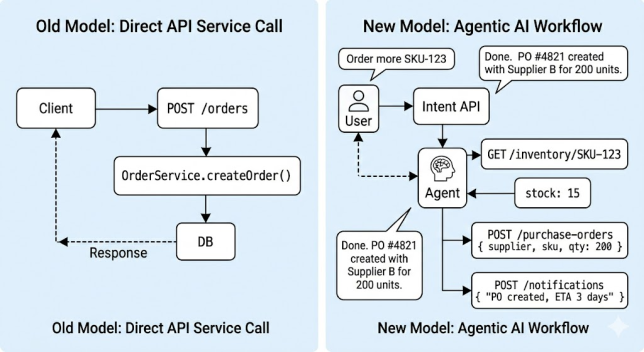
The CRUD operations (GET /inventory, POST /purchase-orders) still exist and are unchanged. The agent simply drives them.
Security Implications You Cannot Ignore
Agentic architectures introduce attack surfaces that traditional backends do not have:
| Risk | Description | Mitigation |
|---|---|---|
| Prompt injection | Malicious data in tool results hijacks agent behavior | Sanitize all tool outputs before re-injecting into LLM context |
| Privilege escalation | Agent calls APIs beyond user’s permission scope | Propagate OAuth2 token into every downstream API call the agent makes |
| Unbounded tool calls | Agent executes destructive operations in a loop | Rate-limit tool calls per job; require confirmation for destructive actions |
| Data exfiltration | Agent reads sensitive data then leaks it in response | Tag sensitive fields; strip them before injecting into LLM context |
AI Prompts for This Topic
Prompt 1: Design an intent API
What it does: Generates an intent endpoint design including validation, async handling, and webhook callbacks.
When to use it: When planning to add an AI agent layer to an existing Java microservice.
"Design a production-ready Spring Boot Intent API for an e-commerce backend that accepts natural-language goals, validates them against user roles, dispatches to a LangChain4j agent, and delivers results via webhook. Include security checks and error handling."Prompt 2: Migrate a specific CRUD flow to agent
What it does: Takes your existing REST endpoints and designs an agent-based wrapper for a given business workflow.
When to use it: When you want to make an existing process AI-driven without rewriting core services.
"Given these REST endpoints: [paste your OpenAPI spec], design a LangChain4j agent that can autonomously execute the employee onboarding workflow — create account, assign permissions, send welcome email, and schedule orientation — from a single natural-language instruction."Prompt 3: Agent security audit
What it does: Reviews your agent tool definitions for prompt injection vulnerabilities and privilege escalation risks.
When to use it: Before deploying an agent to production.
"Review these LangChain4j @Tool methods for security vulnerabilities, specifically prompt injection risks through tool return values and potential privilege escalation through downstream API calls. Suggest fixes for each issue found."See Also
- Spring AI + LangChain4j: Building Production-Ready AI Microservices in Java
- LLM Gateway Pattern for Java Microservices
- Building a RAG Application with Spring AI in Java
- Java Virtual Threads: Complete Production Guide
- Microservices Architecture with Spring Boot
- Spring Boot REST API Development Guide
- Java Design Patterns for Enterprise Applications
- CompletableFuture and Async Programming in Java
- Implementing Semantic Search in Java
- Building a Neural Network from Scratch in Java
Frequently Asked Questions
Will AI agents make Java backend developers obsolete?
No — they shift the work. The demand for developers who can build reliable, well-documented, idempotent APIs (Tier 1) actually increases in an agentic world because agents depend entirely on the quality of the services they call. What becomes less necessary is building every individual workflow by hand — agents can compose those from your Tier 1 capabilities dynamically.
How do I make my existing REST APIs “agent-friendly”?
Four things matter most: (1) excellent OpenAPI documentation with clear operation descriptions — the LLM uses these to decide when to call each tool; (2) idempotent endpoints with idempotency keys so agents can safely retry; (3) structured error responses (RFC 7807 Problem Detail format) so agents can reason about failures; and (4) consistent naming that describes business intent, not implementation detail (POST /inventory/reorder beats POST /inventory/update).
What is the difference between an agent and a workflow engine like Temporal?
Temporal (and similar tools like Apache Airflow, Prefect) run deterministic, human-defined workflows. An AI agent runs emergent workflows defined at runtime by LLM reasoning. They are complementary: use Temporal for compliance-critical processes where the steps must be auditable and reproducible; use an AI agent for flexible, open-ended workflows where the path to completion is not known in advance. Some architectures use both — Temporal for the outer workflow lifecycle, AI agent for individual decision nodes.
How should I handle an agent that takes a destructive action by mistake?
Implement compensating transactions for every agent-callable write operation. If an agent calls POST /orders/cancel incorrectly, your system should be able to restore the order. This is the same saga pattern used in distributed transactions, applied to agent actions. Also implement a “dry run” mode: POST /intent?dryRun=true executes the agent loop but substitutes all write tools with read-only simulation stubs.
Conclusion
The shift from Copilot to autonomous agents is not a distant future — it is happening in Java backends right now. REST APIs will not disappear; they will be redesigned as agent-callable capability libraries. CRUD will not vanish; it will be driven by intent rather than direct client calls. For Java developers, the opportunity is enormous: the production reliability, observability, and tooling of the Java ecosystem are exactly what is needed to make agentic systems trustworthy at enterprise scale. The developers who thrive will be those who design their APIs with agent consumers in mind from the start.
No Comments yet!