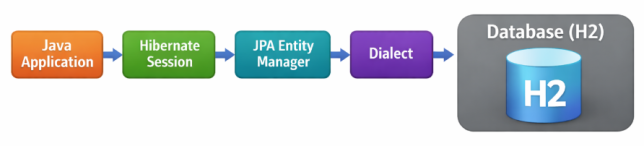
Are you struggling to bridge the gap between your Java objects and your relational database in the modern Jakarta EE era? If you’ve ever felt buried under boilerplate JDBC code or confused by the transition to Hibernate 7, you aren’t alone.
In modern Java development, bootstrapping EntityManager in Hibernate 7 is the foundational step for any robust data persistence layer. Hibernate 7 has fully embraced Jakarta Persistence 3.2, bringing stricter standards, better performance, and a move toward Java 17+ features. This version marks a significant milestone in the decoupling of Hibernate-specific logic from standard JPA interfaces.
TL;DR
- 🚀 Requirements: Java 17+ and Jakarta Persistence 3.2 (complete
jakarta.*namespace transition). - 🏗️ Architecture:
EntityManagerFactory(EMF) is a thread-safe singleton;EntityManager(EM) is for short-lived units of work. - ⚙️ Configuration: Use XML (
persistence.xml) for stability; use Programmatic (PersistenceConfiguration) for cloud-native/dynamic environments. - ⚠️ Critical Warning: Never create a new
EntityManagerFactoryper request. It leads to catastrophic Metaspace OOM errors.
The Problem: The Complexity of Manual Data Handling
Managing database connections manually is a developer’s nightmare. From opening connections and handling SQL exceptions to mapping result sets back into Java objects, the “traditional” JDBC way is error-prone and tedious. Without a properly bootstrapped EntityManager, your application lacks a unified way to manage entity lifecycles, leading to:
- Memory Leaks: Connections that are never returned to the pool.
- Data Inconsistency: Transactions that aren’t properly synchronized across operations.
- Performance Bottlenecks: The infamous “N+1” query issues that arise when manual fetching isn’t optimized.