
Merge Sort is a classic divide-and-conquer sorting algorithm that recursively splits an array in half, sorts each half independently, and then merges the two sorted halves back together. It guarantees O(n log n) time complexity in all cases — best, average, and worst — making it one of the most reliable general-purpose sorting algorithms. Unlike QuickSort, Merge Sort is stable and does not depend on a good pivot choice.
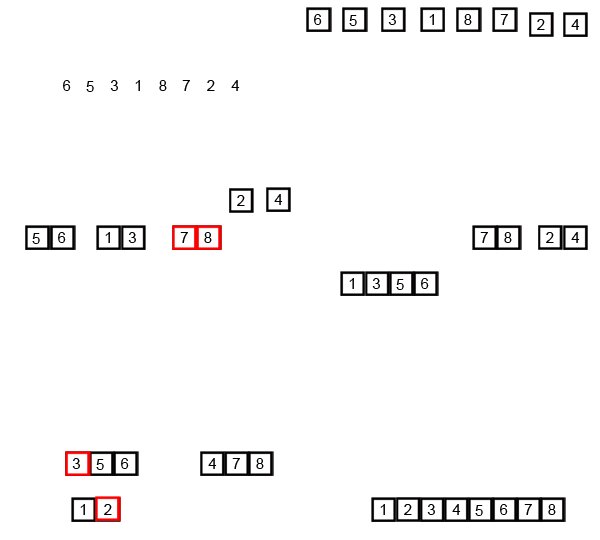
Merge Sort Implementation in Java
import java.io.*;

class MergeSort {

    /**
     * Merges two adjacent sorted sub-arrays of arr[] into a single sorted section.
     *
     * @param arr        the array containing both sub-arrays
     * @param leftStart  starting index of the left sub-array
     * @param rightStart starting index of the right sub-array
     * @param rightEnd   ending index (inclusive) of the right sub-array
     */
    static void merge(int[] arr, int leftStart, int rightStart, int rightEnd) {
        int[] tempArray = new int[arr.length];  // temporary buffer for merged output
        int leftPointer  = leftStart;           // pointer into the left sub-array
        int rightPointer = rightStart;          // pointer into the right sub-array
        int tempIndex    = -1;                  // current write position in tempArray

        // Compare elements from both halves and place the smaller one into tempArray
        while (leftPointer <= rightStart - 1 && rightPointer <= rightEnd) {
            if (arr[leftPointer] < arr[rightPointer]) {
                tempIndex++;
                tempArray[tempIndex] = arr[leftPointer];
                leftPointer++;
            } else {
                tempIndex++;
                tempArray[tempIndex] = arr[rightPointer];
                rightPointer++;
            }
        }

        // Copy any remaining elements from the left half
        if (leftPointer > rightStart - 1) {
            for (int i = rightPointer; i <= rightEnd; i++) {
                tempIndex++;
                tempArray[tempIndex] = arr[i];
            }
        } else {
            // Copy any remaining elements from the right half
            for (int i = leftPointer; i <= rightStart - 1; i++) {
                tempIndex++;
                tempArray[tempIndex] = arr[i];
            }
        }

        // Copy the merged result back into the original array
        for (int i = 0; i <= tempIndex; i++) {
            arr[leftStart + i] = tempArray[i];
        }
    }

    /**
     * Recursively sorts arr[leftIndex..rightIndex] using the merge sort algorithm.
     *
     * @param arr        the array to sort
     * @param leftIndex  starting index of the portion to sort
     * @param rightIndex ending index (inclusive) of the portion to sort
     */
    static void mergeSort(int[] arr, int leftIndex, int rightIndex) {
        if (leftIndex < rightIndex) {
            int midIndex = (leftIndex + rightIndex) / 2;

            mergeSort(arr, leftIndex, midIndex);          // sort the left half
            mergeSort(arr, midIndex + 1, rightIndex);     // sort the right half
            merge(arr, leftIndex, midIndex + 1, rightIndex);  // merge both halves
        }
    }

    public static void main(String[] args) throws IOException {
        BufferedReader reader = new BufferedReader(new InputStreamReader(System.in));

        System.out.println("Enter the number of elements:");
        int elementCount = Integer.parseInt(reader.readLine());

        int[] arr = new int[elementCount];

        for (int i = 0; i < elementCount; i++) {
            System.out.println("Enter element " + (i + 1) + ":");
            arr[i] = Integer.parseInt(reader.readLine());
        }

        mergeSort(arr, 0, elementCount - 1);

        System.out.println("Sorted array:");
        for (int i = 0; i < elementCount; i++) {
            System.out.println(arr[i]);
        }
    }
}
How the Code Works
mergeSort()is a recursive function. IfleftIndex < rightIndex, it computesmidIndexand recursively sorts the left half[leftIndex..midIndex]and the right half[midIndex+1..rightIndex], then callsmerge()to combine them.merge()uses a temporary array (tempArray) as a buffer. Two pointers —leftPointerandrightPointer— walk through the two sub-arrays simultaneously, always picking the smaller element and writing it totempArray.- Remaining elements: when one pointer exhausts its sub-array, the remaining elements of the other sub-array are copied into
tempArrayas-is (they are already in order). - Copy back: the merged
tempArraycontents are written back into the originalarr[]at the correct position starting fromleftStart. - Base case: when
leftIndex == rightIndex, the sub-array has one element and is trivially sorted — the recursion stops.
Sample Output
Enter the number of elements:
5
Enter element 1:
38
Enter element 2:
27
Enter element 3:
43
Enter element 4:
3
Enter element 5:
9

Sorted array:
3
9
27
38
43
Output Explanation
- The input array
[38, 27, 43, 3, 9]is split recursively:[38, 27, 43]and[3, 9]→ further split until single-element sub-arrays. - The merge phase begins from the bottom up:
[27, 38]is merged from[38]and[27];[27, 38, 43]is merged from[27, 38]and[43];[3, 9]is trivially merged. - The final merge combines
[27, 38, 43]and[3, 9]→[3, 9, 27, 38, 43]. - The sorted array is printed one element per line: 3, 9, 27, 38, 43.
See Also
- Implementing Quicksort Algorithm in Java
- Constructing the Minimum Spanning Tree using Prim’s Algorithm in Java
- Implementing 0-1 Knapsack in Java
- Implementing Greedy (Fractional) Knapsack in Java
- Java Program for Longest Common Subsequence (LCS)
Conclusion
Merge Sort’s consistent O(n log n) performance and stability make it the preferred choice when predictable, worst-case-safe sorting is needed. It is the foundation of Java’s Arrays.sort() for object arrays and Python’s Timsort. The key trade-off versus QuickSort is the O(n) extra space required for the temporary merge buffer — but for most applications, that is an acceptable cost for the guaranteed performance.
No Comments yet!