
Ask ten developers which language dominates the AI era and you will get three different answers depending on who they work with. Python developers will say Python, because it runs every major model training pipeline on the planet. TypeScript developers will say TypeScript, because it powers the frontend, the edge, and increasingly the orchestration layer. Java developers will say Java, because it runs the backend systems that millions of users depend on right now. They are all correct — and that is the point.
I learned this the hard way watching a team try to run their Java inventory service and their Python RAG pipeline through the same Node.js orchestration layer, then decide Python should “just handle the business logic too” because it was already there. Three months later they were debugging a billing race condition in asyncio with no transaction support and no useful stack trace. The architecture question is not which language wins — it is which language owns which layer. Getting this wrong is how teams end up with Python microservices struggling to maintain SLAs, TypeScript agents making direct database calls, and Java services trying to run GPU inference.
The Three-Layer AI Stack
Before assigning languages, we need to define the layers clearly. This is a functional decomposition, not a physical one — a single deployment can span layers, but the concerns are distinct.
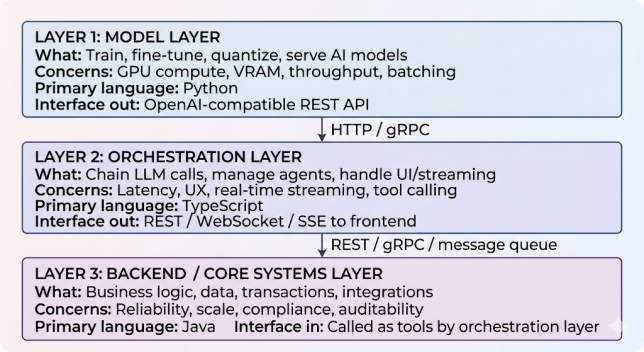
This is not a hard wall between languages. It is a statement of natural fit based on each language’s ecosystem strengths, runtime characteristics, and real-world production track record in AI systems.
Layer 1 — Python: The Model Layer
Python’s ownership of the model layer is not a preference — it is an ecosystem lock-in that has accumulated over 15 years. Every significant AI breakthrough since 2012 shipped Python-first. The runtime interfaces, CUDA bindings, and model formats are Python-native.
# Python owns everything from raw training to optimized serving

# 1. Fine-tuning with QLoRA (4-bit, runs on a single A100)
from transformers import AutoModelForCausalLM, TrainingArguments
from peft import LoraConfig, get_peft_model
from trl import SFTTrainer

model = AutoModelForCausalLM.from_pretrained(
    "mistralai/Mistral-7B-v0.3",
    load_in_4bit=True,              # QLoRA: 4-bit base model
    device_map="auto"
)

lora_config = LoraConfig(r=16, lora_alpha=32, target_modules=["q_proj", "v_proj"])
model = get_peft_model(model, lora_config)

trainer = SFTTrainer(
    model=model,
    train_dataset=dataset,
    args=TrainingArguments(output_dir="./output", num_train_epochs=3)
)
trainer.train()
model.save_pretrained("./my-fine-tuned-model")

# 2. High-throughput serving with vLLM (exposes OpenAI-compatible API)
# Terminal: python -m vllm.entrypoints.openai.api_server
# --model ./my-fine-tuned-model --port 8000

# 3. Embedding model serving with sentence-transformers
from sentence_transformers import SentenceTransformer
from fastapi import FastAPI

app = FastAPI()
model = SentenceTransformer("BAAI/bge-m3")  # state-of-the-art multilingual embeddings

@app.post("/embed")
async def embed(texts: list[str]):
    embeddings = model.encode(texts, normalize_embeddings=True)
    return {"embeddings": embeddings.tolist()}
Why Python owns this layer:
| Capability | Python Status | TypeScript Status | Java Status |
|---|---|---|---|
| PyTorch / TensorFlow | First-class, GPU native | ONNX only (limited) | DJL (ONNX runtime wrapping) |
| Hugging Face transformers | Native library | Transformers.js (CPU only, small models) | No equivalent |
| Custom CUDA kernels | Via CuPy / Triton | ❌ Not possible | ❌ Not possible |
| vLLM / TGI (serving) | Python-native | Client only | Client only |
| Model quantization (GPTQ, AWQ) | Full support | ❌ | ❌ |
The output of the Python model layer is always a standardized API — OpenAI-compatible REST. This is the interface that makes the model layer language-agnostic to its consumers. Nothing in Layers 2 or 3 needs to know or care that the model runs on Python.
Layer 2 — TypeScript: The Orchestration Layer
TypeScript’s rise as the orchestration layer language is one of the more interesting developments in the AI stack. It is not about performance — it is about where orchestration code lives and who writes it.
Orchestration is the code that: calls the LLM, manages conversation history, chains multiple AI calls together, handles streaming output to the UI, calls tools and injects results, and runs in the same process as the frontend or the edge function. TypeScript excels here because:
- It runs in the browser, on the edge (Cloudflare Workers, Vercel Edge), and on Node.js — the same language across the full frontend-to-backend orchestration path
- The major AI orchestration frameworks (Vercel AI SDK, LangChain.js, LlamaIndex.TS) are TypeScript-first
- Streaming responses from LLMs map naturally to TypeScript’s async generator model
- Next.js Server Actions let you call LLMs from a React component with a single async function — no separate API route needed
// TypeScript orchestration layer — this is where the AI "thinking" is coordinated

// 1. Next.js Server Action: LLM call co-located with the component
// app/actions/chat.ts
'use server';
import { streamText, tool } from 'ai';
import { openai } from '@ai-sdk/openai';
import { z } from 'zod';

export async function sendMessage(messages: Message[]) {
  const result = await streamText({
    model: openai('gpt-4o-mini'),
    system: 'You are a helpful Java architecture assistant.',
    messages,
    tools: {
      // Tool: call the Java backend for business data
      getOrderStatus: tool({
        description: 'Get current status of an order',
        parameters: z.object({ orderId: z.string() }),
        execute: async ({ orderId }) => {
          // TypeScript orchestration → Java backend API call
          const res = await fetch(`${JAVA_API}/orders/${orderId}`, {
            headers: { Authorization: `Bearer ${getServiceToken()}` }
          });
          return res.json();
        }
      }),
      // Tool: call the Python embedding service
      searchDocs: tool({
        description: 'Search documentation semantically',
        parameters: z.object({ query: z.string(), topK: z.number().default(5) }),
        execute: async ({ query, topK }) => {
          const res = await fetch(`${PYTHON_RAG_API}/search`, {
            method: 'POST',
            body: JSON.stringify({ query, topK })
          });
          return res.json();
        }
      })
    },
    maxSteps: 5 // agent loop: up to 5 tool-call iterations
  });

  return result.toDataStreamResponse();
}

// 2. Multi-step agent with Vercel AI SDK (TypeScript-native)
// The agent calls tools, observes results, calls more tools — all in TypeScript
async function runOrderAgent(userGoal: string): Promise<string> {
  const { text, steps } = await generateText({
    model: openai('gpt-4o'),
    prompt: userGoal,
    tools: { getOrderStatus, checkInventory, createPurchaseOrder },
    maxSteps: 10,
    onStepFinish: ({ toolCalls, toolResults }) => {
      console.log('Agent step:', toolCalls, toolResults);
    }
  });
  return text;
}

// 3. Streaming to React UI (real-time token display)
// app/components/ChatUI.tsx
'use client';
import { useChat } from 'ai/react';

export function ChatUI() {
  const { messages, input, handleSubmit, isLoading } = useChat({
    api: '/api/chat'
  });

  return (
    <div>
      {messages.map(m => (
        <div key={m.id} className={m.role === 'user' ? 'user' : 'assistant'}>
          {m.content}
        </div>
      ))}
      <form onSubmit={handleSubmit}>
        <input value={input} onChange={e => setInput(e.target.value)} />
        <button type="submit" disabled={isLoading}>Send</button>
      </form>
    </div>
  );
}
How the Code Works
- Server Actions + streamText — the LLM call lives in a server-side TypeScript function, but streams tokens directly to the React component with zero serialization overhead via the AI SDK’s data stream protocol.
- Tools bridge to other layers — the
getOrderStatustool calls the Java REST API;searchDocscalls the Python RAG service. TypeScript orchestrates without owning the data or the model. - maxSteps: 5 — the agent loop runs up to 5 iterations of (LLM call → tool call → result injection). This is the orchestration layer’s job; neither Python nor Java needs to know about the loop.
- useChat hook — Vercel AI SDK’s React hook handles streaming state, message history, loading state, and error display in ~10 lines of client code.
Layer 3 — Java: The Backend / Core Systems Layer
Java’s layer is the most stable of the three — it does not change because AI arrived. What changes is how Java services are called: now they are called as tools by AI agents in the orchestration layer, in addition to being called by traditional REST clients.
// Java backend: unchanged from traditional microservice design,
// but now also serves as tool-callable API for AI agents

// OrderService.java — exposed as both REST endpoint AND AI tool
@RestController
@RequestMapping("/api/orders")
public class OrderController {

    private final OrderService orderService;
    private final MeterRegistry meterRegistry;

    // Traditional REST consumer: mobile app, web frontend
    @GetMapping("/{id}")
    @Timed("orders.get")
    public ResponseEntity<OrderDetail> getOrder(@PathVariable Long id) {
        return orderService.findById(id)
            .map(ResponseEntity::ok)
            .orElse(ResponseEntity.notFound().build());
    }

    // AI-friendly mutation endpoint: idempotent + clear description in OpenAPI
    // @Operation tells the AI agent exactly when to call this
    @Operation(summary = "Create a purchase order",
               description = "Creates a purchase order for a given supplier and SKU. " +
                             "Idempotent: use the same idempotencyKey to safely retry.")
    @PostMapping("/purchase")
    public ResponseEntity<PurchaseOrder> createPurchaseOrder(
            @RequestBody @Valid CreatePurchaseOrderRequest req) {
        PurchaseOrder po = orderService.createPurchaseOrder(req);
        meterRegistry.counter("orders.purchase.created").increment();
        return ResponseEntity.ok(po);
    }

}

// InventoryQueryService.java — high-performance reads for AI tool calls
// AI agents call this dozens of times per session; it must be fast
@Service
public class InventoryQueryService {

    private final InventoryRepository repo;
    private final CaffeineCache localCache; // in-process cache for hot SKUs

    // Cache hot reads — AI agents query inventory repeatedly during planning
    @Cacheable(value = "inventory", key = "#sku",
               unless = "#result.stock < 10")  // don't cache low-stock (volatile)
    public InventoryStatus getInventoryStatus(String sku) {
        return repo.findBySku(sku)
            .map(inv -> new InventoryStatus(
                sku, inv.getAvailableStock(),
                inv.getReservedStock(),
                inv.getReorderPoint(),
                inv.getLeadTimeDays()))
            .orElse(InventoryStatus.notFound(sku));
    }

    // Batch query — AI agents benefit from bulk reads to reduce round trips
    public Map<String, InventoryStatus> getBulkInventoryStatus(List<String> skus) {
        // Single DB query for all SKUs vs N separate queries
        return repo.findBySkuIn(skus).stream()
            .collect(Collectors.toMap(
                Inventory::getSku,
                inv -> new InventoryStatus(inv.getSku(),
                    inv.getAvailableStock(), inv.getReservedStock(),
                    inv.getReorderPoint(), inv.getLeadTimeDays())
            ));
    }

}
How the Code Works
- @Operation description — this OpenAPI annotation is read by AI agents (via TypeScript orchestration layer) to decide when to call the endpoint. Clear, precise descriptions are the most important AI-readiness upgrade you can make to an existing Java service.
- Idempotency — AI agents retry on failure; without idempotency keys, a network hiccup creates duplicate orders. Every mutating AI-callable endpoint needs an idempotency mechanism.
- Batch query endpoint — an AI agent planning a restocking run might check inventory for 50 SKUs. 50 individual HTTP calls vs 1 batch call is a 50x latency difference; design batch variants of hot read endpoints.
- Caching with conditions —
unless = "#result.stock < 10"prevents caching volatile low-stock data while still caching stable high-stock items — important when an AI agent’s tool call must reflect current inventory state.
The Complete Three-Layer Architecture: Real-World Example
Scenario: A user types “Check if we have enough SKU-123 to fulfill the Chicago order and create a purchase order if not” into a chat interface.
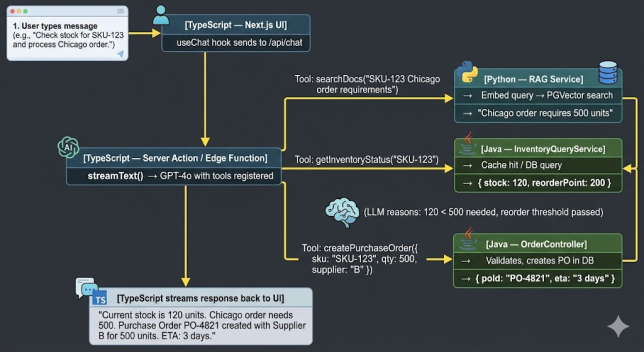
Each language did exactly what it is best at. Python served the embeddings. TypeScript coordinated the agent loop and streamed the response. Java executed the business logic with full ACID guarantees.
When to Break the Pattern
The three-layer assignment is a starting point, not a law:
| Scenario | Natural Fit | Acceptable Exception |
|---|---|---|
| Simple chatbot, small team, no Java infrastructure | TypeScript full-stack (Vercel AI SDK + Python model API) | Skip Java entirely |
| Java team, no TypeScript experience, B2B product | Java handles orchestration with LangChain4j | Skip TypeScript orchestration layer |
| Pure Python shop, <500 req/sec, team is ML-first | Python orchestration (LangChain, FastAPI) | Skip Java backend layer (until scale demands it) |
| Enterprise with existing Java SOA/microservices | Full three-layer (TS → Java, Python model server) | Do not rewrite Java services in Python |
| Edge AI (browser inference, on-device) | TypeScript + ONNX Web / transformers.js | Skip Python model layer entirely |
Language Ecosystem Comparison at Each Layer
| Capability | Python | TypeScript | Java |
|---|---|---|---|
| LLM training | ✅ PyTorch, JAX | ❌ | ❌ |
| Local model inference | ✅ llama.cpp, vLLM | ⚠️ transformers.js (small models) | ⚠️ DJL (limited) |
| AI orchestration SDKs | ✅ LangChain, AutoGen | ✅ Vercel AI SDK, LangChain.js | ✅ LangChain4j, Spring AI |
| Streaming to browser | ⚠️ FastAPI SSE | ✅ Native (Next.js, SSE) | ⚠️ Spring WebFlux SSE |
| Enterprise transaction management | ❌ Limited | ❌ Not designed for it | ✅ @Transactional, JPA, Saga |
| Throughput (req/s, I/O bound) | ⚠️ GIL limited | ✅ Event loop, good at I/O | ✅ Virtual threads, excellent |
| Type safety | ⚠️ Gradual (mypy) | ✅ Strong, compile-time | ✅ Strong, compile-time |
| Observability tooling | ⚠️ Manual setup | ⚠️ Improving | ✅ Micrometer, JFR, OTel auto |
| Serverless/edge cold start | ✅ Fast | ✅ Very fast (edge runtime) | ⚠️ Slow (JVM) / Fast (GraalVM) |
AI Prompts for This Topic
Prompt 1: Three-layer architecture generator
What it does: Designs a complete three-layer AI system with specific technology choices for each layer based on your requirements.
When to use it: When starting a new AI-powered product with a polyglot team.
"Design a three-layer AI architecture for a B2B SaaS product that needs: (1) a fine-tuned domain-specific model for document analysis, (2) a chat interface with streaming, (3) integration with existing Java microservices for billing and user management. Specify the exact frameworks for each layer, the API contracts between layers, and how authentication flows across all three."Prompt 2: TypeScript orchestration layer scaffold
What it does: Generates a Vercel AI SDK agent that calls both Java REST endpoints and a Python RAG service as tools.
When to use it: When setting up the orchestration layer for the first time.
"Generate a Next.js 15 TypeScript AI agent using Vercel AI SDK that has three tools: (1) getCustomerOrders — calls Java REST API at localhost:8080/api/orders; (2) searchProductDocs — calls Python RAG service at localhost:8001/search; (3) createRefund — calls Java REST POST /api/refunds with idempotency key. Include proper TypeScript types, error handling, and streaming response to the UI."Prompt 3: Java service AI-readiness audit
What it does: Reviews your existing Java REST API and identifies changes needed to make it an effective AI agent tool.
When to use it: When preparing existing Java microservices to be called by an AI orchestration layer.
"Review this Java Spring Boot REST controller [paste code or OpenAPI spec] and identify: (1) which endpoints are missing clear @Operation descriptions for AI agents, (2) which mutations need idempotency keys, (3) which read endpoints need batch variants, (4) which response types are too complex for an LLM to parse reliably. Provide the improved version."See Also
- Spring AI + LangChain4j: Building Production-Ready AI Microservices in Java
- From Copilot to Autonomous Agents: How AI Will Replace CRUD APIs
- Java vs Python for AI in 2026: The Hidden Backend War
- AI-Native Backend Design: Rethinking Microservices, Databases, and APIs
- Building a RAG Application with Spring AI in Java
- LLM Gateway Pattern for Java Microservices
- Java Virtual Threads: Complete Production Guide
- Implementing Semantic Search in Java
- Spring Boot REST API Development Guide
- Building a Neural Network from Scratch in Java
Frequently Asked Questions
Does TypeScript really compete with Java for backend AI orchestration?
For the orchestration layer specifically — yes, increasingly. TypeScript’s advantage is not raw performance but developer velocity and co-location with the UI. When a team uses Next.js for the frontend, having the AI orchestration logic in the same TypeScript codebase eliminates a language-switch overhead and lets the same developer reason about both the UI state and the agent loop. For pure backend orchestration with no UI concern (batch jobs, internal pipelines), Java with LangChain4j is equally capable and offers better operational tooling.
Can I use TypeScript for the model layer too with transformers.js?
For small models only. Transformers.js runs ONNX-exported models in the browser or Node.js runtime — this covers use cases like text classification, sentiment analysis, named entity recognition, and small embedding models (under 500M parameters). It does not support 7B+ parameter LLMs, custom CUDA kernels, quantization workflows, or the fine-tuning lifecycle. Use it for edge inference of pre-optimized small models; for anything that requires a GPU, Python remains the only viable option.
How does authentication work across three layers?
The recommended pattern is: a single OAuth2 access token issued by your identity provider is carried from the user through the TypeScript orchestration layer into every Java and Python service call. The orchestration layer attaches the token as a Bearer header on every downstream API call. Java services validate the token and enforce authorization. Python model services validate that calls come from the orchestration layer (service-to-service auth, not user tokens). This ensures the agent cannot call a Java endpoint with higher privileges than the human who initiated the conversation.
Is this three-layer model used by real companies in production?
Yes, this pattern is widely deployed at scale. The specifics vary — some use Node.js instead of Next.js for the orchestration layer, some use different Java frameworks — but the functional separation of model serving (Python), orchestration/streaming (TypeScript/Node), and business logic (Java) is a dominant pattern in enterprise AI systems. The Vercel AI SDK, LangChain4j, and vLLM were all designed with this division of responsibility in mind.
What happens when an AI agent in the TypeScript layer calls a Java endpoint that throws an exception?
The tool execution catches the error and returns it to the LLM as a tool result — for example: {"error": "Order not found: ORD-999"}. A well-configured LLM will incorporate this into its reasoning: “the order does not exist, so I should inform the user rather than continuing to place a purchase order.” The critical design principle: tool errors should be structured and descriptive, not stack traces. Return a JSON error object with a message field the LLM can read and reason about.
Where the Layer Boundaries Blur in Practice
The three-layer model is a starting frame, not a wall. In practice, the interesting architecture decisions happen at the seams. Here are the four boundary cases that come up most often.
When a TypeScript edge function needs GPU inference: You cannot run a 7B model in a Cloudflare Worker. The right answer is to expose the Python model as an OpenAI-compatible endpoint and call it from TypeScript — not to move the model into TypeScript. The boundary holds; the interface is the fix.
When a Java service needs a quick LLM call: This is more common than teams admit — a Java batch job that needs to classify a document, a Spring Boot service that needs to extract structured data from a PDF. The answer is usually Spring AI or LangChain4j directly in the Java service, with the model accessed via HTTP. There is no orchestration layer involved; the Java service is the caller and the Python model is the callee. This is not wrong — the TypeScript orchestration layer is for user-facing, streaming, multi-step agents, not for every LLM call in the system.
When Python starts accumulating business logic: This is the most dangerous drift. It happens when a Python data engineer adds a FastAPI endpoint that “just also handles” order creation because it’s faster than going through the Java service. The problem surfaces six months later during an audit or a compliance incident. Python does not have Spring’s @Transactional, Hibernate’s optimistic locking, or the 10 years of production-hardening behind the Java service layer. This is worth the extra API call.
When the whole team is Python: Honestly, if your entire team is ML engineers and you have no Java backend, running LangChain orchestration from Python is a perfectly valid choice until you hit scale or compliance requirements that demand something stronger. The three-layer model describes the architecture that makes sense when you have the option. If your constraints are different, start with what you have and add layers as the need emerges.
Common Architecture Mistakes
- Using Python for Business Logic
- Mistake: Extending Python AI services to handle billing, orders, or workflows
- Why it’s a problem: Weak transaction support, limited observability, harder to scale reliably
- Fix: Keep Python focused on model tasks (training, inference, embeddings) and move business logic to Java
- TypeScript Agents Querying Databases Directly
- Mistake: AI agents bypass backend services and hit databases
- Why it’s a problem: Breaks abstraction, creates security risks, no audit trail
- Fix: Route all data access through backend APIs and treat them as AI tools
- No Idempotency in AI Actions
- Mistake: AI-triggered POST requests without idempotency
- Why it’s a problem: Agents retry automatically, causing duplicate transactions
- Fix: Use idempotency keys so repeated requests produce the same result safely
- No Batch APIs
- Mistake: Designing APIs for single-item requests
- Why it’s a problem: AI agents call APIs repeatedly, leading to high latency
- Fix: Provide batch endpoints to handle multiple items in one request (10x–50x faster)
- Improper Error Handling for LLMs
- Mistake: Returning stack traces or raw HTTP errors
- Why it’s a problem: LLMs cannot interpret technical errors, breaking the flow
- Fix: Return structured, simple JSON errors that AI can understand and act on
- Using One Language for All Layers
- Mistake: Forcing a single language across the entire system
- Why it’s a problem: Leads to inefficiencies and poor performance in some layers
- Fix: Use the right tool for each layer
- Python → Model layer
- TypeScript → Orchestration
- Java → Backend
Conclusion
The question “which language wins in the AI era?” has a more nuanced answer than any single-language advocate wants to admit. Python wins at the model layer because its ecosystem advantage is structurally entrenched. TypeScript wins at the orchestration layer because AI is a UI-adjacent concern that benefits from a single language spanning client to server. Java wins at the backend layer because enterprise systems demand the reliability, observability, and operational maturity that the JVM ecosystem has perfected over two decades. The developers and teams who thrive in 2026 are not those who picked the “right” language — they are those who understand which language is right for which layer, and design their systems accordingly.
No Comments yet!